- Artificial Intelligence Is Transforming Legal Practice—But So Are Its Risks
- The AI Hallucination Problem Is No Longer Theoretical
- ABA Formal Opinion 512 Changed the Conversation
- When Hallucinations Become Professional Misconduct
- Not Every Hallucination Looks the Same
- Governance Is More Valuable Than Automation
- Client Trust Is Becoming the New Competitive Advantage
- The Future Belongs to Responsible AI
- Final Thoughts
- References
Artificial Intelligence Is Transforming Legal Practice—But So Are Its Risks
Artificial intelligence has rapidly become part of everyday legal work.Lawyers now use AI to research case law, draft contracts, summarise documents, prepare litigation strategies, and communicate with clients.The productivity gains are undeniable.
Yet alongside this transformation, another trend has emerged—one that receives far less attention.AI hallucinations.Not occasional mistakes.Systemic failures that have already resulted in sanctions, judicial criticism, financial penalties, and reputational damage for law firms around the world.
The legal profession is entering a new era in which AI competence is no longer measured by how quickly firms adopt technology.It is measured by how responsibly they govern it.
The AI Hallucination Problem Is No Longer Theoretical
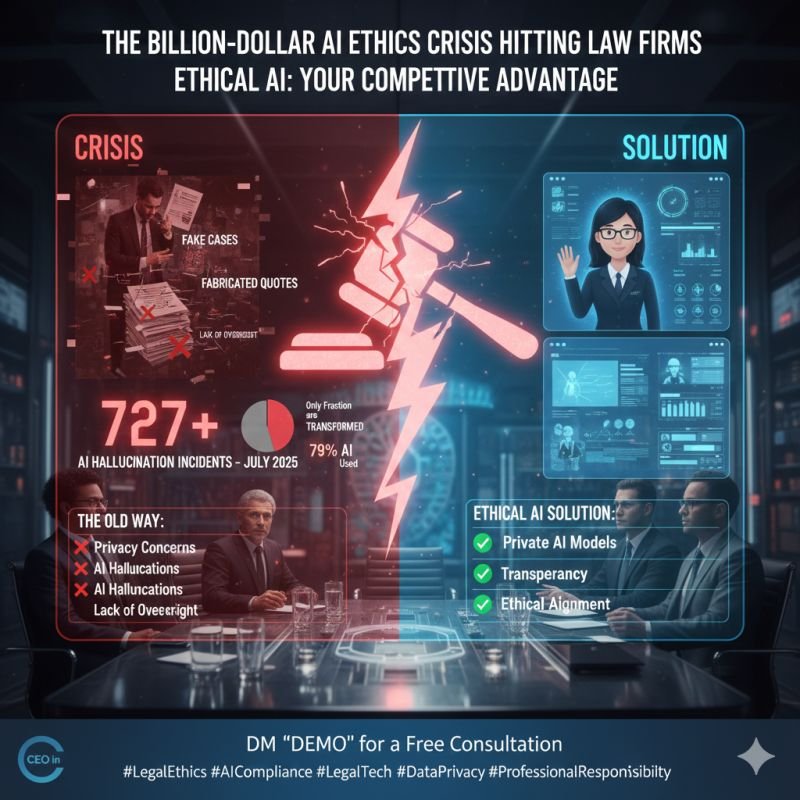
Throughout 2025, courts around the world increasingly encountered legal submissions containing fabricated authorities, inaccurate quotations, and fictitious legal reasoning generated by AI systems.In July 2025 alone, more than fifty publicly reported AI hallucination cases were identified across legal proceedings.
Those cases represent only publicly documented incidents.Many more likely remain undisclosed or are resolved before reaching published decisions.Researchers tracking AI hallucinations in legal practice have now documented hundreds of incidents involving fabricated legal authorities and misleading AI-generated content.The problem is no longer hypothetical.
It is operational.
ABA Formal Opinion 512 Changed the Conversation
On 29 July 2024, the American Bar Association issued Formal Opinion 512, providing the profession’s first comprehensive ethical guidance on lawyers’ use of generative AI.The opinion did not prohibit AI.Instead, it reinforced a principle that has always existed within legal ethics:Technology may assist legal work, but responsibility always remains with the lawyer.
The opinion emphasises several professional duties, including:
- Competence in understanding AI capabilities and limitations.
- Independent verification of AI-generated legal work.
- Protection of confidential client information.
- Appropriate supervision of AI-assisted work.
- Consideration of disclosure obligations where relevant.
In other words, AI may accelerate legal work.It cannot assume professional responsibility.
When Hallucinations Become Professional Misconduct
Several recent cases demonstrate how seriously courts now treat AI-generated errors.Lawyers have faced sanctions after submitting briefs containing fabricated case citations generated by AI.
In other matters, courts have criticised counsel for relying upon non-existent authorities or inaccurate legal quotations without independent verification.Perhaps even more striking is the emerging expectation that lawyers must identify AI errors before documents reach the court.
Failure to detect obvious hallucinations increasingly raises questions not only about technology—but about professional competence.The issue is no longer whether AI made a mistake.
The issue is why the lawyer failed to identify it.
Not Every Hallucination Looks the Same
AI hallucinations appear in several different forms.Some are immediately obvious.Others are remarkably persuasive.
The most common categories include:
1. Fabricated Authorities
The AI invents entirely fictional judicial decisions, legislation, or legal principles.
2. False Quotations
The cited case exists, but the quotation attributed to the judgment does not.
3. Misapplied Legal Reasoning
The citation is genuine.The legal argument is not.The AI draws conclusions unsupported by the authority being referenced.
These errors can easily pass unnoticed if lawyers rely on AI outputs without careful review.
Governance Is More Valuable Than Automation
Many discussions about AI focus on productivity.
How many hours can AI save?How many documents can it draft?How much administrative work can it automate?
These questions matter.But governance matters more.
Every law firm should establish clear policies addressing:
- Which AI tools may be used.
- Which legal tasks always require human review.
- How AI-generated research is verified.
- How confidential information is protected.
- How AI outputs are documented.
- How lawyers receive AI competency training.
- How accountability is maintained throughout the workflow.
Technology alone does not reduce risk.Good governance does.
Client Trust Is Becoming the New Competitive Advantage
Clients increasingly expect law firms to use technology efficiently.They also expect firms to use it responsibly.Forward-looking firms are already treating AI governance as a trust signal rather than merely a compliance exercise.
Many are implementing:
- Private AI environments.
- Secure document processing.
- Human-in-the-loop review systems.
- AI governance policies.
- Audit trails for AI-assisted work.
- Internal AI ethics committees.
- Formal staff training programmes.
Responsible AI is rapidly becoming part of professional reputation.Clients want confidence that innovation will never compromise legal quality.
The Future Belongs to Responsible AI
Industry surveys consistently show that legal professionals believe AI will fundamentally reshape legal services during the coming decade.That prediction is increasingly becoming reality.The firms leading this transition are not abandoning human expertise.They are strengthening it.
Artificial intelligence performs repetitive analysis.Lawyers apply judgment.AI accelerates research.Lawyers verify accuracy.Technology increases efficiency.Governance preserves trust.The objective has never been to replace legal professionals.
It has always been to allow them to focus on the work that only humans can perform.
Final Thoughts
The legal profession has reached an important turning point.Artificial intelligence is no longer experimental.It is becoming part of everyday legal practice.At the same time, AI hallucinations have demonstrated that technological capability does not eliminate professional responsibility.Every document filed with a court.Every contract reviewed.Every legal opinion delivered.Ultimately remains the responsibility of the lawyer whose name appears on it.
The firms that thrive in this new era will not simply adopt AI faster than their competitors.They will build governance frameworks that ensure innovation, accountability, and professional judgment advance together.Because in law, trust has always been the most valuable asset.AI should strengthen that trust—not undermine it.
References
- American Bar Association. Formal Opinion 512: Generative Artificial Intelligence Tools (29 July 2024).
- VinciWorks. AI Hallucinations Crisis in Legal Practice (2025).
- Damien Charlotin. AI Hallucination Cases Database.
- Thomson Reuters. Future of Professionals Report 2025.
- Clio. Legal Trends Report 2025.
- NPR. MyPillow Lawyers Fined Over AI-Generated Citations (2025).
- LawSites. AI Hallucination Sanctions in U.S. Courts (2025).
- Wadsworth v. Walmart Inc., United States District Court, District of Wyoming (2025).
- AI, Justice, and the Spirit of the Law: Why Human JudgmeAI, Justice, and the Spirit of the Law: Why Human Judgment Still Matters
- 2026: The Year Agentic AI Will Transform Legal Practice
- AI Governance Is Failing: Why Principles Alone Are No Longer Enough
- The 3.2-Hour Problem: How AI Is Transforming Contract Review Without Replacing Legal Judgment
- The Silent Revolution in Law Firms: Why AI Adoption Is Becoming a Competitive Advantage