Artificial Intelligence Is Entering a New Phase
For the past few years, most conversations about artificial intelligence in law have focused on one idea: assistance.Lawyers ask questions.AI answers them.A solicitor uploads a contract.AI identifies clauses.A litigator requests a case summary.AI produces one.Useful? Absolutely.Transformational? Not quite.What is emerging in 2026 is fundamentally different.
According to Gartner, by 2026 nearly 40% of enterprise applications will incorporate task-specific AI agents, compared with less than 5% only a few years earlier. Rather than simply responding to prompts, these systems are designed to plan, execute, monitor, and refine entire workflows with minimal human intervention.
For the legal profession, this represents far more than another software upgrade.It signals the beginning of Agentic AI.
From AI Assistants to AI Agents
Most lawyers are already familiar with AI assistants.These systems are reactive.They wait for instructions.A lawyer asks a question.The AI produces an answer.Agentic AI operates differently.Instead of waiting for prompts, AI agents pursue objectives.
They can break complex work into multiple stages, gather information, perform legal research, draft documents, review outputs, and decide what the next step should be—all within predefined boundaries established by human supervisors.
The distinction is significant.An assistant completes individual tasks.An agent manages an entire process.This shift has the potential to reshape how legal work is organised.
Agentic AI Is Already Arriving
Major legal technology providers are already introducing agent-based workflows.
Thomson Reuters has announced expanded CoCounsel capabilities featuring agentic workflows, including autonomous document review and advanced “Deep Research” functions capable of coordinating complex legal research across multiple sources.Meanwhile, LexisNexis Protégé introduces multiple specialised AI agents working together.
Rather than relying on a single large language model, the platform coordinates separate agents responsible for:
- Legal research
- Web research
- Document analysis
- Workflow orchestration
Each agent performs a specialised role while communicating with the others to complete more sophisticated legal tasks.Contract Lifecycle Management (CLM) platforms are evolving in the same direction.Low-risk agreements can increasingly move through drafting, review, negotiation, and approval with minimal human involvement while maintaining predefined governance rules and approval thresholds.
For routine matters, lawyers may soon supervise workflows rather than manually completing every individual step.
Where Agentic AI Creates Value
Unlike traditional AI tools that automate isolated activities, agentic systems operate across complete legal workflows.
Potential applications include:
- Autonomous preparation of litigation files.
- Multi-stage legal research with source verification.
- Intelligent deadline monitoring across matters.
- Contract review followed by drafting recommended amendments.
- Risk assessment supported by multiple legal authorities.
- Scenario modelling for negotiation strategies.
- Continuous monitoring of regulatory changes affecting clients.
The objective is not simply faster drafting.It is reducing the administrative complexity surrounding legal work while allowing lawyers to focus on judgment, advocacy, negotiation, and client relationships.
Governance Will Separate Success from Failure
The excitement surrounding agentic AI should not obscure its challenges.Gartner predicts that more than 40% of agentic AI projects may be cancelled by the end of 2027, not because the technology lacks capability, but because organisations struggle with governance, unclear business value, escalating costs, and unrealistic expectations.Legal practice presents additional complexities.
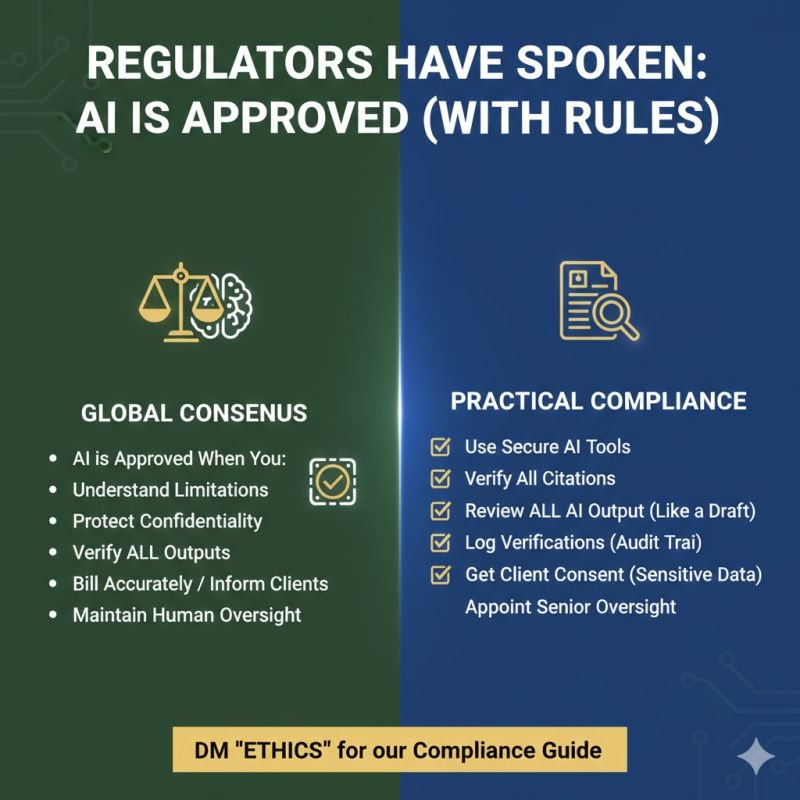
Professional responsibility cannot be delegated.Confidentiality remains paramount.Regulatory compliance must be maintained.Clients continue to expect accountability from human professionals—not autonomous software.For this reason, successful implementation requires more than purchasing technology.It requires governance.
Law firms should establish clear frameworks addressing:
- Human oversight responsibilities.
- Escalation procedures.
- Audit trails documenting AI activity.
- Validation of AI-generated legal analysis.
- Risk assessment before deployment.
- Data privacy and confidentiality controls.
- Vendor transparency regarding agent decision-making.
Technology without governance introduces risk.Governance transforms technology into professional infrastructure.
Human Judgment Becomes More Valuable, Not Less
One common misconception is that increasingly autonomous AI reduces the need for lawyers.The opposite may prove true.As AI assumes greater responsibility for repetitive operational work, the value of uniquely human capabilities increases.Clients do not simply purchase documents.
They purchase judgment.Strategic advice.Ethical reasoning.Negotiation.Advocacy.Professional accountability.Agentic AI may complete the process.Only lawyers remain responsible for the outcome.
This distinction is likely to define the next generation of legal practice.
Preparing Your Firm for the Agentic Era
Law firms considering agentic AI should resist the temptation to automate everything immediately.The firms likely to succeed are adopting a measured approach.Rather than pursuing large-scale transformation, they begin with carefully defined workflows where success can be measured objectively.
Typical starting points include:
- Client intake automation.
- Routine contract review.
- Internal legal research.
- Compliance monitoring.
- Knowledge management.
- Administrative workflow automation.
Each deployment generates experience that informs future governance decisions.Successful firms treat implementation as an ongoing capability-building process rather than a one-time technology project.
Final Thoughts
The legal profession has experienced multiple technological revolutions—from online legal research to electronic discovery and cloud-based practice management.Agentic AI represents the next major transition.Unlike previous generations of legal technology, these systems do not simply support individual tasks.
They coordinate entire workflows.That capability creates extraordinary opportunities for efficiency, consistency, and client service.It also introduces new responsibilities for governance, supervision, and professional accountability.The firms that thrive over the coming decade will not necessarily be those with the most advanced AI.
They will be those that combine technological innovation with disciplined governance, thoughtful implementation, and unwavering human oversight.
In the age of Agentic AI, competitive advantage will come not from replacing lawyers, but from enabling lawyers to focus on the work that only humans can perform.
References
- Gartner. Top Strategic Technology Trends: Agentic AI (2025–2026 Forecasts).
- Gartner. Over 40% of Agentic AI Projects Expected to Be Cancelled by 2027.
- Thomson Reuters. CoCounsel Legal – Agentic Workflows and Deep Research (2026).
- LexisNexis. Protégé AI Platform (2025 Launch).
- National Law Review. Ten AI Predictions for 2026.
- Litera. AI in Legal Tech: Five Predictions for 2026.
- Herbert Smith Freehills. 2026: The Year AI and Legal Technology Become Business as Usual.
- AI Adoption Starts with Trust, Not Technology
- Why AI Adoption Fails in Law Firms: The Middle Management Bottleneck
- The Leadership Gap: Why AI Resistance at the Top Puts Law Firms at Risk
- The AI Copyright Reckoning: Who Owns Creativity in the Age of Generative AI?
- AI Hallucinations Are No Longer a New Problem. They Are Becoming a Professional Responsibility Problem.