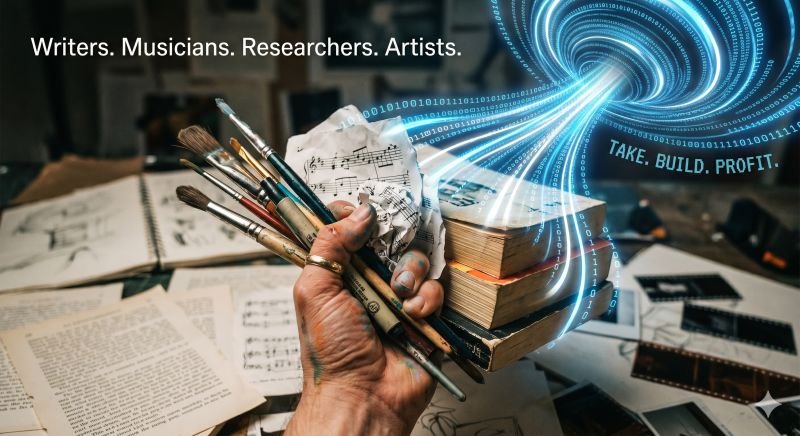
The Internet Was Built by Creators
The modern internet exists because of creators.Writers produced articles and books. Musicians created songs. Researchers published studies. Artists shared images, designs, and ideas.
Some chose to make their work freely available. Others licensed it, sold it, or protected it behind subscriptions and paywalls.Regardless of the model, one principle remained consistent:
Creators retained the right to decide how their work would be used.
The rise of generative AI has challenged that principle.
The Training Data Debate
Modern AI systems require enormous amounts of data.To build large language models and image-generation systems, companies have collected and processed vast quantities of online content.Supporters argue this process is transformative and legally protected under doctrines such as fair use.
Critics argue that many AI systems were trained using copyrighted works without permission, compensation, or meaningful transparency.The result is one of the most significant intellectual property disputes in modern technology.
The Meta Lawsuit and the LibGen Allegations
Recent litigation has intensified this debate.A group of publishers and authors, including novelist Scott Turow, filed legal action against Meta, alleging that copyrighted books were used to train AI models without authorization.
Central to the allegations are claims that materials sourced from LibGen—a well-known repository of pirated books—were incorporated into training datasets.If proven, the implications extend far beyond a single company.
The case raises fundamental questions about how AI developers acquire training data and what legal obligations accompany that process.
A Larger Industry Pattern?
The controversy surrounding AI training data is not limited to one organization.Across the industry, creators have increasingly challenged the assumption that publicly accessible content is automatically available for unrestricted AI training.Several major lawsuits involving authors, publishers, artists, and media organizations are currently testing the boundaries of copyright law in the AI era.
The core dispute is simple:
Should AI companies obtain permission before using copyrighted works to train commercial models?
Or should large-scale data extraction be considered legally permissible without explicit authorization?
The Shift from Opt-Out to Opt-In
One of the most important policy debates concerns consent.Many creators argue that the current approach effectively forces rights holders into an opt-out system, where content may be used unless they discover the usage and object.Critics contend that this reverses traditional copyright principles.
Instead, they advocate for an opt-in model where creators actively choose whether their work can be used for AI training and receive compensation when it is.Supporters of licensing frameworks argue that such systems could balance innovation with creator rights.
Emerging Licensing Models
Not every AI company is pursuing the same strategy.A growing number of organizations are entering licensing agreements with publishers, media companies, and rights holders.These agreements demonstrate that commercial AI development and creator compensation are not mutually exclusive.
Rather than relying on legal uncertainty, licensing provides:
- Transparency
- Predictability
- Compensation
- Reduced litigation risk
- Stronger public trust
As the market matures, licensing may become a defining feature of responsible AI governance.
Why This Matters Beyond Copyright
The debate is about more than intellectual property.
It touches broader questions concerning:
- Consent
- Ownership
- Transparency
- Economic fairness
- Trust in AI systems
Generative AI derives value from human creativity.As a result, many argue that creators should have a meaningful role in determining how that value is created and distributed.
Conclusion
The future of AI will not be determined solely by technical capability.It will also be shaped by decisions about ownership, permission, and compensation.The central question facing policymakers, courts, and technology companies is not whether AI can learn from human creativity.It is whether the people who create that value retain the right to decide how their work is used.As copyright disputes continue to move through courts around the world, one reality is becoming increasingly clear:The conversation is no longer about whether creators matter in the AI economy.It is about how their rights will be protected within it.
References
Authors Guild – Statements on AI Training and Copyright.
- U.S. Copyright Office – Copyright and Artificial Intelligence Reports.
- World Intellectual Property Organization (WIPO) – AI and Intellectual Property Resources.
- European Commission – Copyright Framework and AI Regulation.
- Ongoing litigation involving AI model training and copyrighted works in U.S. federal courts.
- Academic research on licensing models for generative AI systems.
- AI Adoption Starts with Trust, Not Technology
- Why AI Adoption Fails in Law Firms: The Middle Management Bottleneck
- The Leadership Gap: Why AI Resistance at the Top Puts Law Firms at Risk
- The AI Copyright Reckoning: Who Owns Creativity in the Age of Generative AI?
- AI Hallucinations Are No Longer a New Problem. They Are Becoming a Professional Responsibility Problem.