The Legal Profession Is Changing Quietly
Not every revolution arrives with dramatic headlines.Some begin with small operational decisions that, over time, reshape an entire profession.Artificial intelligence is creating exactly that kind of transformation in legal practice.
The firms leading this change are not necessarily the largest or the oldest. They are the firms that understand how to integrate AI strategically while preserving the professional judgment that defines legal services.
The 2025 Legal Industry Report illustrates this transition clearly.
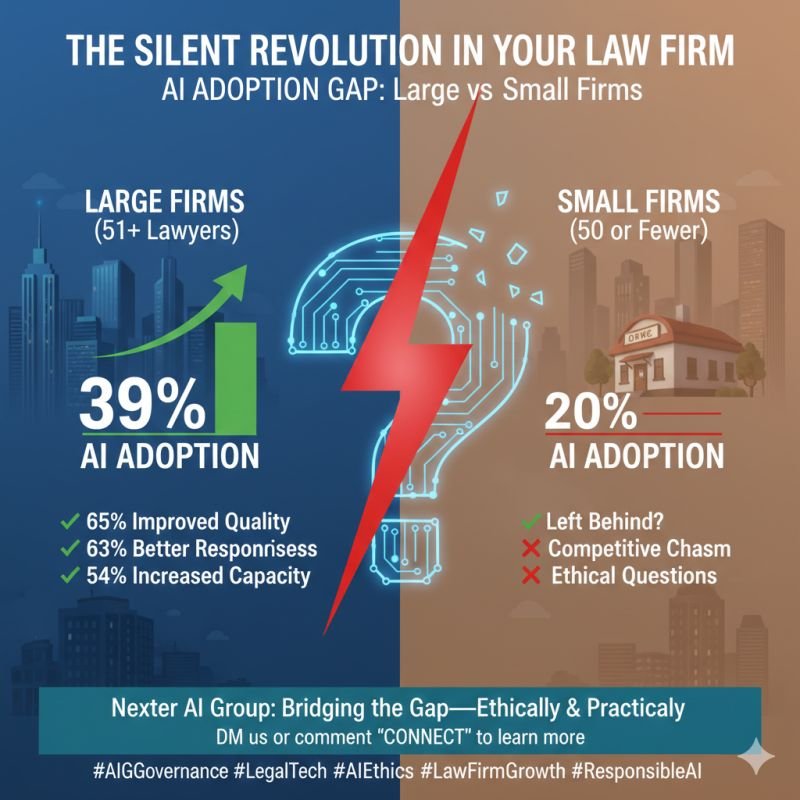
Law firms with more than 50 lawyers report AI adoption rates of approximately 39%, while firms with 50 lawyers or fewer remain closer to 20%.At first glance, these figures appear to describe a technology gap.In reality, they reveal something far more significant.They point to an emerging competitive divide.
AI Adoption Is Becoming a Business Strategy
Technology has never been valuable simply because it exists.Its value comes from changing how organisations work.Across the legal profession, firms already using AI report measurable operational improvements.
Industry research shows:
- 65% report improved work quality
- 63% report better client responsiveness
- 54% report increased work capacity
These outcomes are not merely about efficiency.They influence profitability, client satisfaction, employee wellbeing, and long-term competitiveness.
When lawyers spend less time on repetitive administrative work, they gain more time for strategic thinking, negotiation, advocacy, and client relationships.AI creates capacity not just speed.
The Risk Facing Smaller Firms
Large firms often receive the greatest attention when discussing legal technology.Yet the greatest strategic challenge may belong to smaller practices.Solo practitioners, boutique firms, and regional practices often operate with limited budgets, smaller support teams, and fewer dedicated technology specialists.
Many serve communities where access to legal services already remains limited.If AI adoption continues to accelerate primarily among larger firms, the gap between large and small practices could widen considerably.
This is not simply a question of technology.It is a question of access to justice.Smaller firms that cannot improve efficiency may struggle to compete on response times, pricing, and client experience—even when the quality of their legal advice remains exceptional.
The Real Challenge Is Not Technology
Many lawyers believe AI adoption is primarily about selecting software.It rarely is.The greater challenge lies in organisational change.
Successful firms ask different questions.
- Which legal tasks genuinely require human judgment?
- Which repetitive activities can safely be automated?
- Where should human review remain mandatory?
- How should confidential client information be protected?
- How should AI outputs be verified before reaching clients?
These are governance questions.Technology simply provides the tools.Leadership determines how those tools are used.
Responsible AI Protects Professional Judgment
The legal profession is built on trust.Clients rely on lawyers to exercise independent judgment, maintain confidentiality, and provide advice tailored to complex human situations.Artificial intelligence should strengthen these responsibilities—not weaken them.The most successful implementations therefore follow a simple principle:AI manages repetitive work. Lawyers retain responsibility for professional judgment.
For example, AI may:
- Draft an initial contract summary.
- Highlight unusual clauses.
- Organise disclosure documents.
- Conduct preliminary legal research.
- Prepare first drafts of routine correspondence.
Lawyers then review, interpret, refine, and make the final decisions.Technology enhances professional expertise rather than replacing it.
AI Governance Matters More Than Ever
As AI becomes increasingly integrated into legal workflows, governance becomes a competitive advantage.
Every firm should establish clear policies addressing:
- Human oversight requirements
- Client confidentiality
- Data security
- Quality assurance
- Regulatory compliance
- Audit trails
- Accountability for AI-assisted decisions
Governance is not an obstacle to innovation.It is what makes innovation sustainable.Without clear governance, efficiency gains may come at the expense of professional responsibility.
Bridging the Gap
The future of legal practice should not become a divide between technology-rich firms and everyone else.Smaller firms possess important advantages.They often make decisions faster.They can redesign workflows without multiple layers of approval.They maintain closer relationships with clients.
When supported by practical AI education and responsible implementation, these firms can adopt modern technology without sacrificing their independence or values.The objective is not to compete with larger firms by becoming larger.
It is to compete by becoming smarter.
Final Thoughts
Artificial intelligence is quietly transforming legal practice.The firms adopting AI responsibly are improving service quality, increasing capacity, and responding to clients more effectively.Those delaying adoption risk more than operational inefficiency.They risk falling behind in a profession where client expectations continue to evolve.
The future of legal practice will not belong simply to the firms with the biggest technology budgets.It will belong to those that combine innovation with governance, efficiency with ethics, and automation with professional judgment.The silent revolution has already begun.The only remaining question is whether your firm will lead it—or struggle to catch up.
References
- American Bar Association. Legal Technology Survey Report 2025.
- Clio. Legal Trends Report 2025.
- Thomson Reuters. Future of Professionals Report 2025.
- Bloomberg Law. Legal Operations Survey 2025.
- McKinsey & Company. The State of AI 2025.
- World Economic Forum. Future of Jobs Report 2025.
- OECD. OECD Principles on Artificial Intelligence.
- European Union. EU Artificial Intelligence Act.
- AI Adoption Starts with Trust, Not Technology
- Why AI Adoption Fails in Law Firms: The Middle Management Bottleneck
- The Leadership Gap: Why AI Resistance at the Top Puts Law Firms at Risk
- The AI Copyright Reckoning: Who Owns Creativity in the Age of Generative AI?
- AI Hallucinations Are No Longer a New Problem. They Are Becoming a Professional Responsibility Problem.