- Artificial Intelligence Is Not Replacing Lawyers—It Is Helping Save the Profession
- The Burnout Crisis Is Real
- AI Is Removing the Wrong Work—Not the Important Work
- From Exhaustion to Higher-Value Work
- New Roles Are Emerging Across the Legal Industry
- Why Some Practice Areas Are Leading Adoption
- Responsible AI Matters More Than Rapid AI
- Technology Cannot Replace Human Judgment
- Conclusion
- References
Artificial Intelligence Is Not Replacing Lawyers—It Is Helping Save the Profession
For years, discussions about artificial intelligence in law have focused on one question:
Will AI replace lawyers?The evidence increasingly suggests that this may be the wrong question.
A more important question is emerging:Can AI help save lawyers from the growing burnout crisis affecting the legal profession?
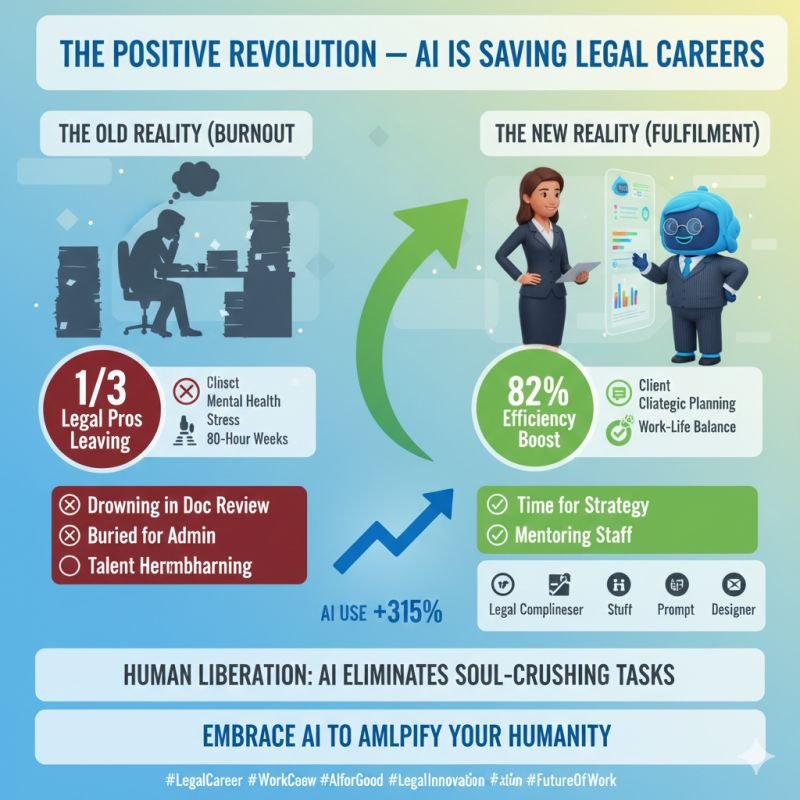
Across many jurisdictions, legal professionals report unprecedented levels of stress, emotional exhaustion, and dissatisfaction. Long hours, administrative overload, and constant pressure have created an environment where talented lawyers are questioning whether they can remain in practice.
Ironically, the technology many feared might eliminate legal careers may instead become one of the profession’s strongest tools for preserving them.
The Burnout Crisis Is Real
Legal practice has never been an easy profession.High client expectations, complex regulations, tight deadlines, and significant professional responsibility create constant pressure.Recent industry research paints a concerning picture.Nearly one-third of legal professionals report considering leaving the profession because of mental health challenges, burnout, or chronic workplace stress.This is not simply a wellbeing issue.It is a business issue.
Burnout contributes to:
- higher staff turnover
- recruitment difficulties
- lower productivity
- reduced client satisfaction
- increased operational costs
- declining institutional knowledge
When experienced lawyers leave, firms lose far more than employees—they lose years of expertise and client relationships.
AI Is Removing the Wrong Work—Not the Important Work
One of the biggest misconceptions surrounding AI is that it replaces legal judgment.In practice, today’s legal AI is far better suited to eliminating repetitive administrative work than replacing professional expertise.
Modern AI systems can assist with:
- first-draft document preparation
- contract review
- legal research
- document summarisation
- client intake
- matter categorisation
- information extraction
- workflow automation
These are tasks that consume enormous amounts of lawyer time without necessarily requiring complex legal reasoning.The lawyer remains responsible for analysis, judgment, strategy, ethics, and client advice.AI simply removes much of the repetitive work surrounding those decisions.
From Exhaustion to Higher-Value Work
The most significant benefit of AI may not be speed.It may be the ability to allow lawyers to spend more time doing work that only humans can perform.
Instead of spending hours reviewing repetitive clauses, lawyers can focus on:
- strategic legal advice
- negotiation
- advocacy
- client relationships
- mentoring junior colleagues
- business development
- complex problem solving
Research consistently shows that legal professionals using AI report improvements in productivity, allowing them to dedicate more time to higher-value legal work rather than routine administration.This represents a shift from working longer hours to working more intelligently.
New Roles Are Emerging Across the Legal Industry
Rather than eliminating legal careers, AI is also creating entirely new professional opportunities.
Law firms are increasingly developing positions such as:
- Legal AI Specialists
- AI Governance Officers
- Legal Operations Professionals
- Legal Engineers
- Prompt Engineering Specialists
- AI Risk and Compliance Advisors
These roles combine legal expertise with technology, governance, ethics, and operational improvement.As AI adoption grows, legal knowledge becomes more—not less—valuable when paired with technological literacy.
Why Some Practice Areas Are Leading Adoption
AI adoption is not occurring evenly across legal practice.Practice areas involving high volumes of documentation have been among the earliest beneficiaries.
Immigration lawyers, for example, manage extensive client information, visa applications, supporting documentation, and procedural requirements.
AI can automate many administrative aspects of these workflows while leaving legal strategy entirely under professional supervision.
Similar patterns are emerging across:
- personal injury
- civil litigation
- employment law
- commercial contracts
- compliance
- regulatory advisory work
In each case, AI primarily reduces administrative burden rather than replacing legal reasoning.
Responsible AI Matters More Than Rapid AI
None of this suggests that firms should automate without caution.
Legal practice depends upon:
- confidentiality
- professional responsibility
- client trust
- regulatory compliance
- independent legal judgment
AI outputs require verification.Lawyers remain accountable for every document submitted, every recommendation made, and every decision affecting a client.The most successful firms are not those deploying AI everywhere.They are those implementing AI where it clearly enhances professional work while maintaining robust governance and human oversight.Efficiency without accountability creates risk.
Responsible AI combines both.
Technology Cannot Replace Human Judgment
Clients rarely hire lawyers because they produce documents.
They hire lawyers because they need:
- judgment
- empathy
- negotiation
- advocacy
- strategic thinking
- ethical decision-making
These remain fundamentally human capabilities.Artificial intelligence can prepare information.It cannot replace professional responsibility.
The future of legal practice therefore belongs not to AI alone, but to lawyers who understand how to work alongside intelligent systems while preserving the trust at the heart of the profession.
Conclusion
Artificial intelligence is often described as a disruptive force in law.In reality, its greatest contribution may be far more human.By reducing repetitive administrative work, improving efficiency, and allowing lawyers to focus on strategic, meaningful legal practice, AI has the potential to make legal careers more sustainable—not less.The firms that succeed will not simply adopt AI.They will implement it responsibly, combining technology with governance, ethics, and human judgment.The future does not belong to lawyers who compete with AI.
It belongs to lawyers who use AI to become better lawyers.
References
- NetDocuments. AI-Driven Legal Tech Trends Report 2025.
- MyCase & American Bar Association. Legal Industry Report 2025.
- NetDocuments. 315% Growth in AI Adoption Among Legal Professionals (2025).
- Akerman LLP. The AI Legal Landscape in 2025: Beyond the Hype.
- Thomson Reuters. Future of Professionals Report 2025.
- Clio. Legal Trends Report 2025.
- AI Adoption Starts with Trust, Not Technology
- Why AI Adoption Fails in Law Firms: The Middle Management Bottleneck
- The Leadership Gap: Why AI Resistance at the Top Puts Law Firms at Risk
- The AI Copyright Reckoning: Who Owns Creativity in the Age of Generative AI?
- AI Hallucinations Are No Longer a New Problem. They Are Becoming a Professional Responsibility Problem.