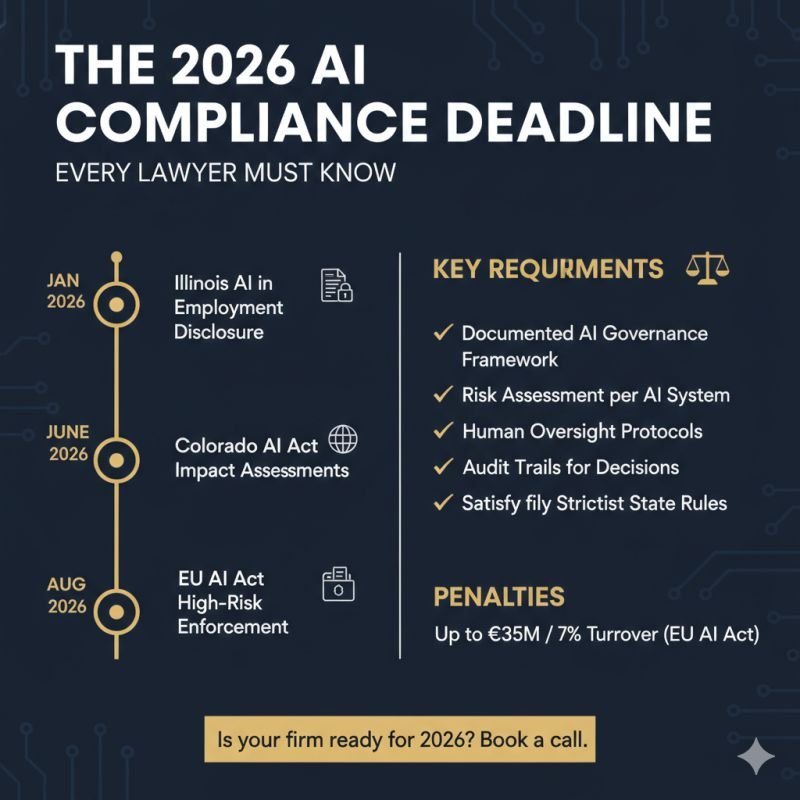
August 2, 2026 Could Become One of the Most Important Dates for Law Firms Using AI
Artificial intelligence has rapidly become part of everyday legal practice.Law firms now use AI to draft documents, review contracts, summarize case files, conduct legal research, support client communication, and automate administrative workflows. These technologies offer significant efficiency gains, but they also introduce new regulatory responsibilities.
Beginning on 2 August 2026, a major portion of the European Union AI Act becomes fully applicable. At the same time, several U.S. states—including Colorado, Illinois, California, New York, and Pennsylvania—are introducing or expanding AI-related legal obligations.For law firms, AI governance is no longer simply an innovation initiative.
It is becoming a compliance requirement.
The EU AI Act Changes the Conversation
The EU AI Act introduces the world’s first comprehensive legal framework governing artificial intelligence.Rather than regulating AI as a single technology, the Act classifies AI systems according to the level of risk they create.Certain AI applications are considered high-risk, particularly where they affect fundamental rights, employment, education, public services, or the administration of justice.
Importantly, not every AI tool used by a law firm is automatically classified as high-risk. The classification depends on how the AI system is used, its intended purpose, and whether it falls within one of the high-risk categories defined by the Act.
For organizations deploying high-risk AI systems, the Act introduces obligations including:
- Comprehensive risk management processes
- Human oversight throughout AI-assisted decision-making
- Technical documentation and record-keeping
- Transparency obligations
- Ongoing monitoring and governance
- Demonstrating regulatory compliance before deployment where applicable
Non-compliance may lead to administrative fines of up to €35 million or 7% of worldwide annual turnover, depending on the nature of the violation.
AI Regulation Is Expanding Beyond Europe
Although the EU AI Act receives most attention, regulatory activity is accelerating globally.Several U.S. jurisdictions have introduced AI governance requirements affecting businesses and professional services.
Examples include:
- Colorado AI Act requiring governance policies and risk management obligations for certain high-risk AI systems.
- Illinois expanding transparency obligations where AI influences employment-related decisions.
- New York introducing AI-related continuing legal education (CLE) requirements for attorneys.
- Pennsylvania providing guidance regarding disclosure obligations for AI-assisted court submissions.
- California continuing to develop one of the country’s most active AI regulatory environments.
The result is an increasingly complex compliance landscape for firms operating across multiple jurisdictions.
What This Means for Law Firms
Using AI responsibly is no longer simply a technical decision.It has become an issue of professional governance.
Law firms should begin establishing clear internal frameworks covering:
- AI governance policies
- Human review procedures
- Risk assessments for AI-assisted workflows
- Documentation and audit trails
- Confidentiality and data protection controls
- Staff training and AI competency
- Client disclosure policies where appropriate
The American Bar Association has already reinforced that existing professional duties—including competence, confidentiality, supervision, and communication—continue to apply when lawyers use generative AI.Technology does not reduce professional responsibility.
If anything, it increases the importance of governance.
Compliance Is Becoming a Competitive Advantage
Many firms still approach AI primarily as an efficiency tool.Leading firms increasingly view it differently.Clients are beginning to ask how AI is being used, what safeguards exist, and how confidential information is protected.
Strong AI governance therefore creates value beyond regulatory compliance.
1-It strengthens client trust.
2-It reduces operational risk.
3-It supports responsible innovation.
And it demonstrates that technology is enhancing professional judgment rather than replacing it.
Final Thoughts
The legal profession has always adapted to new technologies—from digital research databases to electronic discovery and cloud-based practice management.Artificial intelligence represents another transformation.The difference is that this time, regulators are moving almost as quickly as the technology itself.Law firms that prepare now will be better positioned to meet regulatory expectations while continuing to benefit from AI-powered innovation.The question is no longer whether AI belongs in legal practice.The question is whether your governance framework is ready for the responsibilities that come with it.
References
- European Union. Regulation (EU) 2024/1689 (Artificial Intelligence Act).
- European Commission. AI Act Implementation Timeline.
- American Bar Association. Formal Opinion 512: Generative Artificial Intelligence Tools (2024).
- K&L Gates. Understanding the EU AI Act and Compliance Obligations.
- Wilson Sonsini. 2026 AI Regulatory Developments.
- Colorado Artificial Intelligence Act.
- Illinois Artificial Intelligence Video Interview Act and related AI employment guidance.
- Paxton AI. 2025 State Bar AI Guidance Survey
- AI Adoption Starts with Trust, Not Technology
- Why AI Adoption Fails in Law Firms: The Middle Management Bottleneck
- The Leadership Gap: Why AI Resistance at the Top Puts Law Firms at Risk
- The AI Copyright Reckoning: Who Owns Creativity in the Age of Generative AI?
- AI Hallucinations Are No Longer a New Problem. They Are Becoming a Professional Responsibility Problem.