- The Biggest Problem Facing Law Firms Isn't Talent
- Burnout Is Becoming a Business RiskAcross the legal profession, burnout has reached concerning levels.
- Lawyers Are Spending Too Much Time on Work That Doesn't Require Lawyers
- AI Doesn't Replace Judgment—It Protects It
- Capacity Creates Better Client Experience
- Sustainable Firms Are Designed, Not Worked Harder
- The Future of Legal Practice Is Cognitive, Not Administrative
- Conclusion
- References
The Biggest Problem Facing Law Firms Isn’t Talent
Most conversations about the legal profession focus on recruitment.Finding better lawyers.Retaining associates.Developing future partners.Yet many firms are overlooking a more fundamental problem.
Capacity.
The issue is not that lawyers have become less capable.It is that the systems surrounding them increasingly prevent them from doing their best work.Burnout is not simply an individual wellbeing issue.It is often the visible symptom of poorly designed operational systems.
Burnout Is Becoming a Business RiskAcross the legal profession, burnout has reached concerning levels.
Recent studies show:
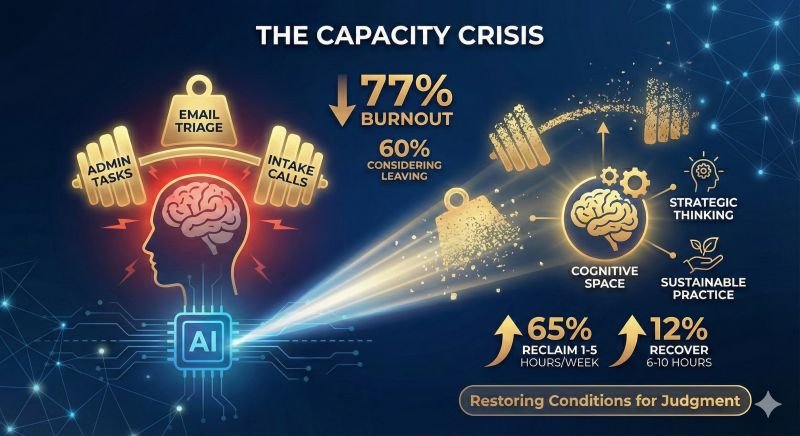
- Approximately 77% of Massachusetts lawyers report experiencing burnout.
- Around 60% of lawyers nationwide have considered leaving the profession because of stress.
- Replacing an experienced lawyer can cost firms hundreds of thousands of pounds once recruitment, onboarding, lost productivity, and client disruption are considered.
These figures represent more than a human challenge.They represent a strategic business risk.
Lawyers Are Spending Too Much Time on Work That Doesn’t Require Lawyers
Many lawyers imagine burnout is caused primarily by difficult cases or demanding clients.The evidence suggests something different.
A significant source of stress comes from repetitive administrative work, including:
- Managing overflowing inboxes.
- Responding to routine client enquiries.
- Scheduling consultations.
- Chasing documents.
- Providing status updates.
- Switching constantly between administrative and legal tasks.
Individually, these activities seem minor.Collectively, they fragment attention, interrupt deep thinking, and consume the cognitive energy required for legal judgment.The problem is not the volume of legal work.
It is the volume of non-legal work surrounding it.
AI Doesn’t Replace Judgment—It Protects It
One of the most common misconceptions about legal AI is that its primary purpose is replacing lawyers.In reality, its greatest value often lies elsewhere.AI can reduce the administrative burden that prevents lawyers from focusing on the work only they can perform.
Modern AI systems can:
- Respond instantly to new enquiries.
- Prioritise urgent matters.
- Draft routine communications.
- Summarise lengthy documents.
- Organise case information.
- Automate scheduling and follow-up.
These tasks do not require legal judgment.Removing them allows lawyers to apply judgment where it matters most.
Capacity Creates Better Client Experience
The benefits extend beyond internal efficiency.
When lawyers spend less time on repetitive administration, clients experience:
- Faster response times.
- More consistent communication.
- Better preparation.
- More thoughtful legal advice.
- Greater confidence in the firm’s professionalism.
Research suggests firms that significantly reduce response times often improve revenue without increasing marketing expenditure.The reason is simple.More enquiries become consultations.More consultations become clients.
Better systems create better outcomes.
Sustainable Firms Are Designed, Not Worked Harder
For decades, many firms addressed capacity problems with a familiar solution:Work longer.Bill more hours.Hire more people.These approaches eventually reach their limits.Technology offers a different path.Instead of asking lawyers to work harder, firms can redesign the systems surrounding legal work.Automation should not eliminate lawyers.It should eliminate unnecessary friction.
The Future of Legal Practice Is Cognitive, Not Administrative
As AI continues to mature, the role of lawyers becomes increasingly clear.Routine administration becomes automated.Information becomes instantly accessible.Document drafting becomes faster.The remaining source of competitive advantage is no longer speed.It is judgment.Strategic thinking.Negotiation.Empathy.Ethical decision-making.Client relationships.These are the capabilities clients ultimately pay for.
Conclusion
The legal profession does not face a talent crisis.It faces a capacity crisis.Burnout is not inevitable.It is often the consequence of systems that ask highly trained professionals to spend too much of their day performing work that technology can now support.The most successful firms will not simply adopt AI.They will redesign their operations so that lawyers spend more time exercising judgment and less time managing administrative complexity.Because the true purpose of AI is not to make lawyers work faster.
It is to create the conditions in which lawyers can do their best work.
References
- Rev Legal Burnout Survey (2025)
- Massachusetts Lawyer Well-Being Study
- ABA Journal – Attorney Wellbeing Report (2024)
- MyCase AI Guide (2025)
- Clio Legal Trends Report (2025)
- American Bar Association – Lawyer Well-Being Initiative
- AI Adoption Starts with Trust, Not Technology
- Why AI Adoption Fails in Law Firms: The Middle Management Bottleneck
- The Leadership Gap: Why AI Resistance at the Top Puts Law Firms at Risk
- The AI Copyright Reckoning: Who Owns Creativity in the Age of Generative AI?
- AI Hallucinations Are No Longer a New Problem. They Are Becoming a Professional Responsibility Problem.