- Adoption Is Growing Faster Than Oversight
- Technology Problems Are Usually Governance Problems
- Governance Is Not About Slowing Innovation
- Clients Are Beginning to Ask Different Questions
- AI Strategy Is Really Business Strategy
- Competitive Advantage Comes From Responsible Implementation
- Final Thought
- References
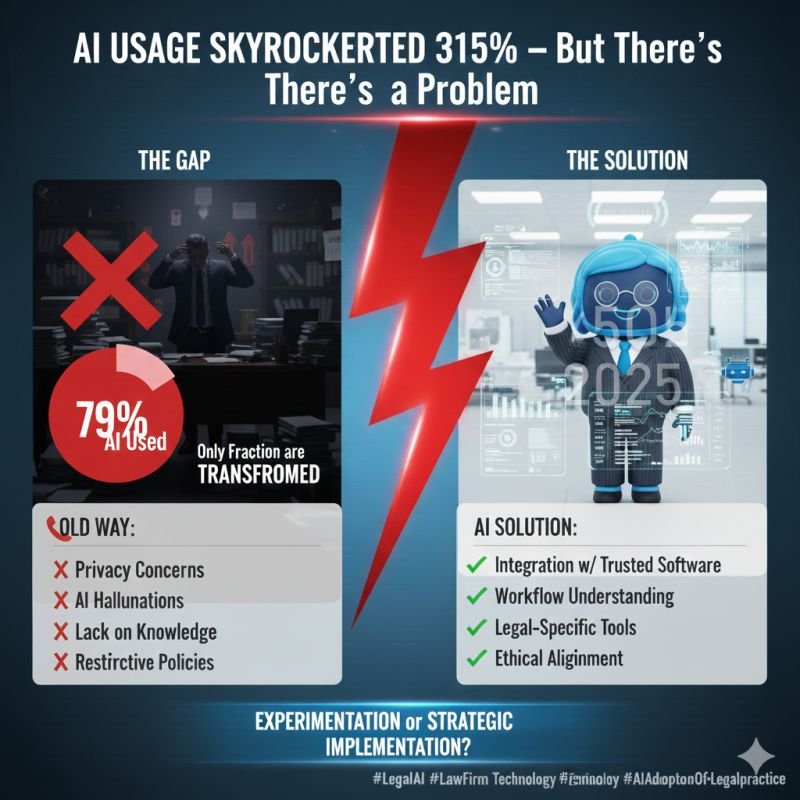
Artificial intelligence is no longer the future of legal practice.It is already embedded in everyday work.Lawyers use AI to summarise contracts, draft correspondence, conduct legal research, review discovery documents, analyse regulations, and support client communication.The technology has arrived.Governance has not.
This creates one of the largest hidden risks facing the legal profession today.
Adoption Is Growing Faster Than Oversight
Over the past two years, AI adoption within law firms has accelerated dramatically.Lawyers increasingly experiment with generative AI individually, while firms gradually introduce organisation-wide tools.Yet many firms share one characteristic.They purchased technology before designing governance.Software is easy.Policies are difficult.
Technology vendors can install an AI platform within days.Creating ethical review procedures, approval workflows, confidentiality safeguards, supervision structures, audit mechanisms, and accountability policies may take months.Many firms simply skip that step.The result is predictable.Different lawyers use different AI tools.Different departments create different practices.Nobody knows which prompts are acceptable.
Nobody knows what client information can safely be entered.Nobody knows who is responsible when AI makes a mistake.The organisation appears innovative from the outside.Internally, it operates without consistent standards.
Technology Problems Are Usually Governance Problems
When AI failures appear in headlines, the technology often receives the blame.In reality, the underlying cause is usually governance.Hallucinated legal citations.Confidential information uploaded into public systems.Unverified legal advice.Biased outputs.Inadequate disclosure.
None of these failures exist because AI exists.They exist because organisations failed to define how AI should be used.The same AI system can become either a productivity advantage or a regulatory liability depending on the governance framework surrounding it.Technology is rarely the weakest link.Human systems are.
Governance Is Not About Slowing Innovation
Many firms still view governance as bureaucracy.It isn’t.Good governance accelerates adoption.
When lawyers understand:
- which tools are approved,
- which tasks may be automated,
- where human review is mandatory,
- how outputs should be verified,
- what documentation must be retained,
they use AI with confidence instead of hesitation.Clear rules reduce uncertainty.Uncertainty slows innovation far more than governance ever does.The fastest organisations are rarely those with the fewest policies.
They are the ones with the clearest ones.
Clients Are Beginning to Ask Different Questions
For years, clients evaluated legal services based on expertise, reputation, responsiveness, and price.Those questions remain important.But another question is emerging.How are you using AI?Sophisticated corporate clients increasingly expect transparency.They want assurance that confidential information remains protected.They want to understand whether AI contributed to legal work.They want confidence that human professionals remain accountable for every important decision.
In other words, clients are no longer evaluating only legal capability.They are evaluating governance capability.Trust increasingly depends on both.
AI Strategy Is Really Business Strategy
Many firms still treat AI as an IT initiative.That is a mistake.AI affects recruitment.Pricing.Knowledge management.Client service.Risk management.Marketing.Professional development.Compliance.Operational efficiency.
None of these belong exclusively to the IT department.Successful AI implementation therefore requires leadership, not simply software procurement.Managing partners must define objectives.Practice leaders must redesign workflows.Compliance teams must establish safeguards.Lawyers must understand both capabilities and limitations.Technology supports the strategy.
It cannot create the strategy.
Competitive Advantage Comes From Responsible Implementation
The legal market is entering a new phase.Simply using AI will soon provide little competitive advantage.Most firms will eventually have access to similar tools.The differentiator will become something else.Which firms deploy AI consistently?
Which firms maintain client trust?Which firms satisfy regulatory expectations?Which firms can demonstrate accountability?Those capabilities cannot be purchased through software licences.
They are organisational capabilities.They are governance capabilities.And they may become one of the defining competitive advantages of modern legal practice.
Final Thought
Artificial intelligence changes how legal work is performed.Governance determines whether that change creates value or risk.Law firms do not need more AI tools.They need clearer decisions about how those tools fit within professional responsibility.Technology may transform legal practice.
Governance determines whether that transformation strengthens—or undermines—the profession itself.
References
- American Bar Association. Formal Opinion 512: Generative Artificial Intelligence Tools (2024).
- Thomson Reuters. Future of Professionals Report 2025.
- Clio. Legal Trends Report 2025.
- MyCase. Legal Industry Report 2025.
- Gartner. Top Strategic Technology Trends (2025–2026).
- European Union. EU AI Act.
- National Institute of Standards and Technology (NIST). AI Risk Management Framework 1.0.
- AI Adoption Starts with Trust, Not Technology
- Why AI Adoption Fails in Law Firms: The Middle Management Bottleneck
- The Leadership Gap: Why AI Resistance at the Top Puts Law Firms at Risk
- The AI Copyright Reckoning: Who Owns Creativity in the Age of Generative AI?
- AI Hallucinations Are No Longer a New Problem. They Are Becoming a Professional Responsibility Problem.