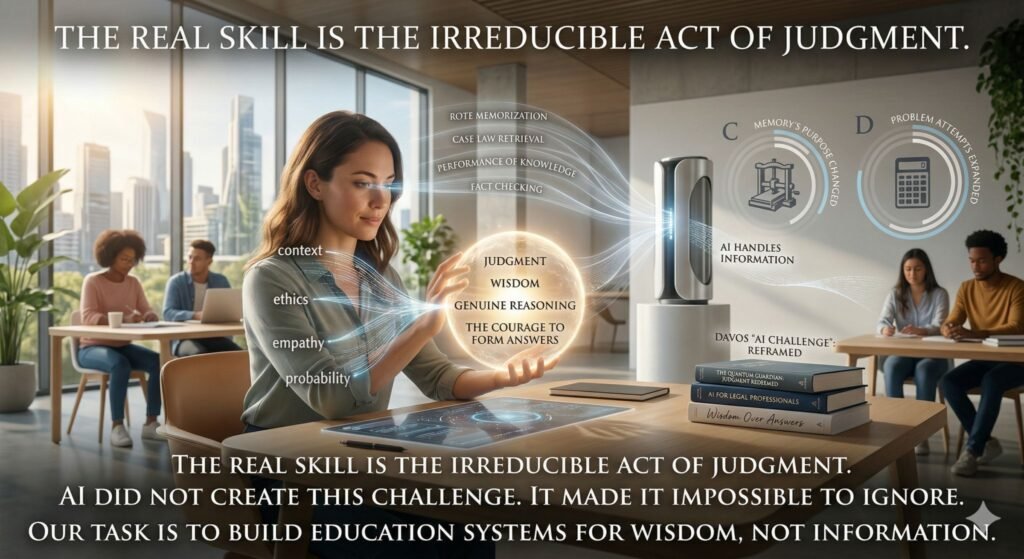
The Growing Fear Around AI in Education
One of the most common concerns about artificial intelligence is that students are becoming too dependent on it.Teachers worry that AI tools are writing essays.Universities worry that students are outsourcing assignments.Parents worry that critical thinking skills are disappearing.These concerns are understandable.
If AI can instantly summarize a book, solve a problem, or draft an answer, what incentive remains for students to think independently?Yet this debate may be focused on the wrong question.Perhaps AI is not destroying thinking.Perhaps it is exposing what genuine thinking has always been.
Every Revolutionary Tool Changed Learning
History shows that transformative technologies often trigger fears about intellectual decline.When the printing press emerged, many worried that people would stop memorizing information.When calculators became common, educators feared students would lose mathematical ability.When search engines appeared, critics argued that people would no longer learn facts.None of these predictions proved entirely true.
Instead, each technology changed how humans used their cognitive abilities.Memory did not disappear.Mathematics did not vanish.Knowledge did not become irrelevant.The focus simply shifted toward higher-value skills.AI may represent the next stage of this evolution.
Information Is Not the Same as Thinking
For decades, many educational systems have rewarded information retrieval.Students memorized facts.They repeated definitions.They reproduced information during examinations.While knowledge remains important, information recall is not the same thing as reasoning.
Real thinking involves something deeper:
- Evaluating evidence
- Understanding context
- Forming judgments
- Challenging assumptions
- Defending conclusions
- Revising beliefs when confronted with new information
These abilities cannot be reduced to memorization.And they become even more important in an AI-driven world.
What AI Removes
Artificial intelligence excels at tasks that involve:
- Information retrieval
- Summarization
- Pattern recognition
- Content generation
- Basic analysis
Tasks that once required hours can now be completed in minutes.This reality is causing concern among educators.Yet it may also be creating an opportunity.AI is removing many activities that were often mistaken for learning itself.The ability to retrieve information quickly is becoming less valuable when machines can perform that function instantly.As a result, education may be forced to focus on the skills machines cannot easily replicate.
What AI Makes More Visible
When AI handles routine cognitive tasks, something becomes easier to see.Judgment.Reasoning.Wisdom.Students can no longer rely solely on memorization to demonstrate competence.
Instead, they must show they can:
- Interpret information
- Evaluate competing perspectives
- Solve ambiguous problems
- Make decisions under uncertainty
- Explain and defend their reasoning
These abilities have always mattered.AI simply makes them impossible to ignore.
The Shift From Knowledge to Judgment
Across professions, the most valuable skill is increasingly not knowing more information.It is making better decisions.A lawyer’s value is not merely remembering legal cases.It is applying legal principles to complex human situations.A physician’s value is not simply knowing medical facts.It is exercising judgment under uncertainty.
A business leader’s value is not possessing information.It is making sound decisions with incomplete information.The same principle applies to education.Students who thrive in the AI era may not be those who know the most facts.They may be those who develop the strongest judgment.
Why the Deskilling Concern Is Real
This does not mean concerns about AI should be dismissed.There are genuine risks.Overreliance on AI can weaken foundational skills.Students who never practice reasoning independently may struggle to develop intellectual confidence.Critical thinking still requires effort.
Reflection still requires practice.The challenge is not whether students should use AI.The challenge is how they use it.AI should become a tool for deeper thinking, not a substitute for thinking.
Rethinking Education for the AI Era
The arrival of AI presents educators with an opportunity to redesign learning around what matters most.
Future-focused education should prioritize:
- Critical thinking
- Ethical reasoning
- Communication skills
- Creativity
- Problem-solving
- Judgment under uncertainty
These capabilities remain uniquely human and increasingly valuable.Instead of competing with AI at information retrieval, students should learn how to work alongside it effectively.
Conclusion
Artificial intelligence is transforming education.But its greatest impact may not be reducing human intelligence.It may be exposing the difference between knowledge and wisdom.For decades, educational systems often rewarded information transfer because it was easy to measure.AI now performs much of that work instantly.What remains is the harder challenge.The challenge of thinking.The challenge of judgment.The challenge of wisdom.AI did not create this challenge.It simply made it impossible to ignore.
References
- Shannon Vallor – Research on technology ethics and human flourishing.
- OECD Future of Education and Skills Reports.
- UNESCO Guidance on Generative AI in Education.
- Research on Critical Thinking and AI-Assisted Learning.
- Literature on Human Judgment in the Age of Artificial Intelligence.
- AI Adoption Starts with Trust, Not Technology
- Why AI Adoption Fails in Law Firms: The Middle Management Bottleneck
- The Leadership Gap: Why AI Resistance at the Top Puts Law Firms at Risk
- The AI Copyright Reckoning: Who Owns Creativity in the Age of Generative AI?
- AI Hallucinations Are No Longer a New Problem. They Are Becoming a Professional Responsibility Problem.