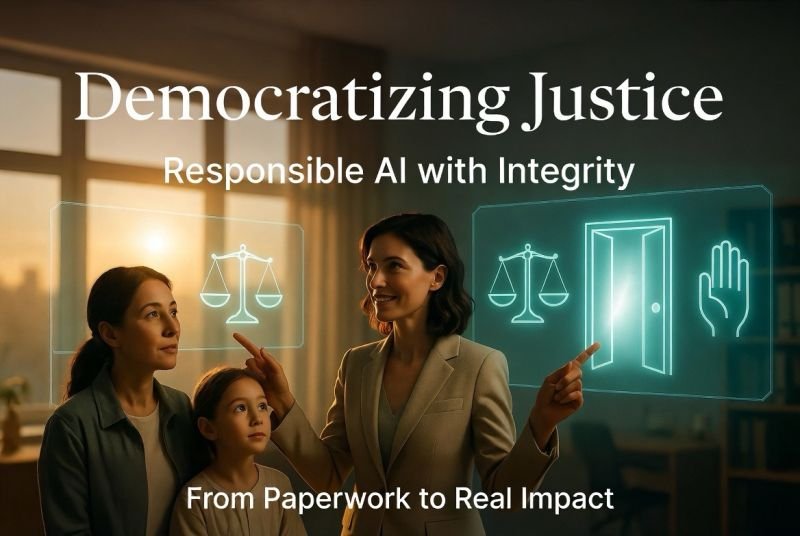
The Access to Justice Crisis
Across the world, legal aid organizations face the same challenge.Demand continues to rise.Resources remain limited.Lawyers, volunteers, and case workers are expected to help more people with fewer staff, tighter budgets, and increasingly complex legal systems.For millions of people, justice is not denied because the law fails them.
It is denied because no one has the capacity to help in time.Artificial intelligence cannot solve that problem alone.But when implemented responsibly, it can help legal professionals reach more people without compromising quality, ethics, or human judgment.
When Demand Outpaces Capacity
Consider a typical legal aid organization.
Every week it receives requests involving:
- Housing evictions
- Immigration applications
- Family law disputes
- Employment claims
- Social benefit appeals
- Domestic violence protection orders
Each case requires documents to review, forms to complete, deadlines to monitor, and legal research to perform.Many organizations simply cannot keep up.The result is longer waiting lists, overwhelmed staff, and vulnerable people losing access to timely legal support.
AI as an Enabler—Not a Replacement
The most successful legal aid organizations are not replacing lawyers with AI.They are removing administrative work that prevents lawyers from practicing law.
Responsible AI can assist with:
- Client intake and triage
- Document summarization
- Translation support
- Initial legal research
- Drafting first versions of standard documents
- Organizing evidence
- Identifying urgent cases
- Tracking procedural deadlines
These tasks consume significant time but still require human review.AI accelerates the process.Humans remain responsible for legal advice, advocacy, and final decisions.
Responsible AI Requires Governance
Legal aid organizations often serve society’s most vulnerable populations.That makes governance essential.
Responsible AI implementation should include:
- Human oversight for every legal decision
- Data privacy and confidentiality protections
- Bias testing across different communities
- Transparent documentation
- Audit trails
- Compliance with applicable regulations, including the EU AI Act where relevant
- Staff training on appropriate AI use
Technology without governance risks creating new forms of inequality.Governance ensures technology supports justice rather than undermining it.
Expanding Access to Justice
When implemented carefully, AI allows legal aid providers to serve substantially more people without reducing professional standards.
Potential benefits include:
- Faster response times
- Better case prioritization
- Reduced administrative burden
- More consistent documentation
- Greater volunteer efficiency
- More time for client counseling
- Increased courtroom preparation
- Improved organizational sustainability
Instead of replacing legal professionals, AI increases the amount of meaningful human work they can perform.
Human Judgment Remains Irreplaceable
AI can organize information.It cannot replace professional judgment.Legal aid requires far more than processing documents.
It requires understanding:
- Personal circumstances
- Cultural context
- Trauma
- Ethical considerations
- Client trust
- Strategic judgment
- Compassion
These remain fundamentally human responsibilities.The value of AI lies in creating more space for them.
The Future of Legal Aid
The organizations likely to achieve the greatest impact will not simply adopt AI.They will adopt responsible AI.That distinction matters.Technology alone does not improve access to justice.
Good governance does.Organizations that combine AI capabilities with strong ethical oversight may be able to expand services, reduce staff burnout, improve case preparation, and help more people receive timely legal support.
Conclusion
Artificial intelligence represents one of the most significant opportunities legal aid organizations have seen in decades.Used responsibly, it can reduce administrative burdens, improve efficiency, and expand access to legal services for communities that have historically been underserved.But AI should never replace the human values at the heart of legal aid.Justice depends not only on speed.It depends on empathy, professional judgment, accountability, and trust.Responsible AI succeeds when it strengthens those qualities—not when it attempts to replace them.
References
- Research on AI and access to justice in legal services.
- European Union AI Act and AI governance guidance.
- Studies on responsible AI implementation in public sector organizations.
- Research on legal technology and nonprofit legal services.
- Literature on human-centered AI and legal ethics.
- AI Adoption Starts with Trust, Not Technology
- Why AI Adoption Fails in Law Firms: The Middle Management Bottleneck
- The Leadership Gap: Why AI Resistance at the Top Puts Law Firms at Risk
- The AI Copyright Reckoning: Who Owns Creativity in the Age of Generative AI?
- AI Hallucinations Are No Longer a New Problem. They Are Becoming a Professional Responsibility Problem.