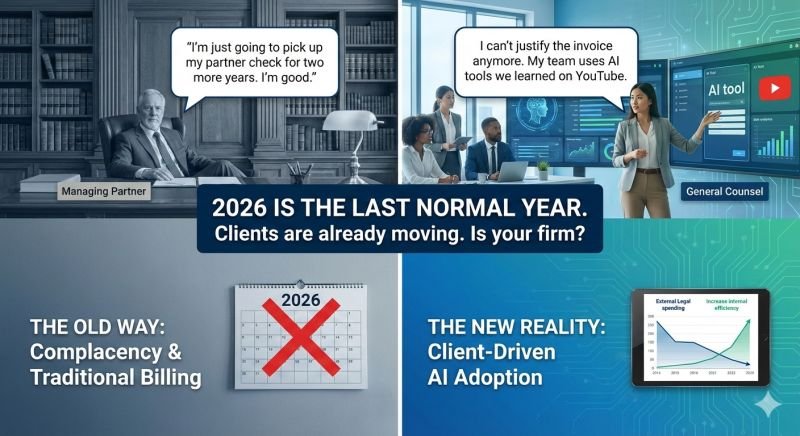
The Last Normal Year
For many years, law firms competed on familiar advantages.Reputation.Expertise.Relationships.Billable hours.Those strengths still matter.But a new factor is rapidly reshaping the legal market:
How clients experience your firm’s use of AI.
The legal profession is not approaching a distant technological shift.It is already living through one.
Clients Are Changing Faster Than Many Firms
The biggest transformation is not happening inside law firms.It is happening inside their clients’ organizations.
Corporate legal departments increasingly have access to AI tools that can:
- Review routine contracts
- Summarize legal documents
- Draft first versions of agreements
- Organize due diligence
- Conduct preliminary legal research
Work that was once automatically outsourced is now often completed internally.The decision is not necessarily about quality.It is frequently about economics.If routine work can be completed faster and at lower cost, clients naturally begin questioning traditional billing models.
AI Is Changing Client Expectations
Clients are no longer evaluating firms only by legal expertise.They are increasingly evaluating them by efficiency, responsiveness, transparency, and technological capability.
They ask questions such as:
- Can this work be completed faster?
- Can AI reduce unnecessary costs?
- Does this firm use modern legal technology responsibly?
- Are lawyers spending time on strategic advice rather than repetitive tasks?
- The firms that answer “yes” convincingly gain a competitive advantage.
Expertise Alone Is No Longer Enough
Excellent lawyers remain essential.But excellence alone may no longer differentiate a firm.Clients assume technical competence.What distinguishes firms today is how they combine professional judgment with modern tools.The value increasingly lies not in producing documents faster.It lies in helping clients solve more complex problems with greater speed, clarity, and confidence.
Clients Need to See the Difference
Many firms quietly experiment with AI behind the scenes.That is valuable.But invisible innovation creates limited competitive advantage.
Clients notice visible improvements such as:
- Faster response times
- Predictable fixed-fee services
- More efficient onboarding
- Better communication
- Clearer project updates
- Improved turnaround on routine work
Technology becomes meaningful only when clients experience its benefits directly.
AI Should Expand Value, Not Simply Reduce Costs
One common mistake is viewing AI purely as a cost-cutting tool.The strongest firms use AI differently.
They free lawyers from repetitive work so they can invest more time in:
- Strategic advisory services
- Complex negotiations
- Risk management
- Client relationships
- Business development
- Industry specialization
AI changes where lawyers create value—not whether they create value.
Preparing for the Next Phase of Legal Practice
The legal profession is unlikely to disappear.It is likely to evolve.Successful firms will be those that continuously adapt alongside their clients rather than reacting after expectations have already changed.The competitive question is becoming increasingly simple:
Can your clients clearly see how your firm is improving because of AI?
If the answer is yes, trust grows.If the answer is no, clients may assume another firm can deliver the same expertise more efficiently.
Conclusion
Every generation of legal professionals experiences a moment when established ways of working begin to shift.Artificial intelligence represents one of those moments.The firms that succeed will not necessarily be those with the largest technology budgets.They will be the firms that combine legal excellence with visible innovation, practical efficiency, and client-centered service.Because clients rarely pay for technology.They pay for better outcomes.
References
- Research on AI adoption in legal services.
- Studies on legal technology and client expectations.
- Reports on digital transformation within professional services.
- Research on corporate legal operations and AI.
- Literature on the future of legal practice.
- AI Adoption Starts with Trust, Not Technology
- Why AI Adoption Fails in Law Firms: The Middle Management Bottleneck
- The Leadership Gap: Why AI Resistance at the Top Puts Law Firms at Risk
- The AI Copyright Reckoning: Who Owns Creativity in the Age of Generative AI?
- AI Hallucinations Are No Longer a New Problem. They Are Becoming a Professional Responsibility Problem.