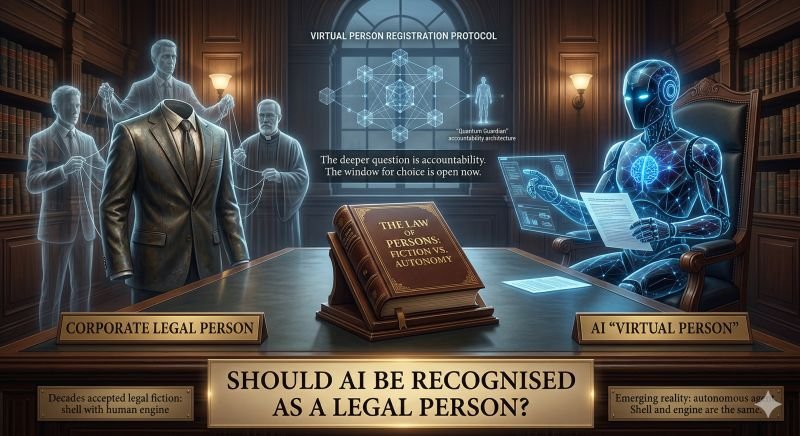
- The Question That Law Can No Longer Avoid
- What Is Legal Personhood?
- AI Changes the Equation
- The Accountability Problem
- Legal Personhood Is Not About Rights
- Why Existing Law May Become Insufficient
- One Possible Alternative: Registered AI Identity
- Governance Before Philosophy
- Human Responsibility Must Remain Central
- Conclusion
- References
The Question That Law Can No Longer Avoid
Should artificial intelligence be recognised as a legal person?For many people, the idea sounds absurd.AI is not human. It has no emotions, no citizenship, no biological existence.Yet the law has never limited legal personhood to human beings.Corporations have been recognised as legal persons for centuries.
Ships, trusts, foundations, and public institutions can all possess legal rights and responsibilities despite lacking consciousness.The real question has never been who is alive.It has always been:
Who can act in the legal world?
As autonomous AI systems become increasingly capable of making decisions without direct human intervention, that question is becoming impossible to ignore.
What Is Legal Personhood?
Legal personhood is frequently misunderstood.It does not mean something is human.It simply means the law recognises an entity as capable of holding legal rights, duties, assets, or liabilities.
Legal persons can:
- Own property
- Enter contracts
- Sue or be sued
- Hold assets
- Bear legal responsibilities
Corporations do all of these every day.No one argues they possess consciousness.Legal personhood was created because modern society required a practical legal framework—not because corporations deserved human status.
AI Changes the Equation
Traditional legal entities never act entirely alone.A corporation may sign a contract, but human directors make the decisions.A trust has trustees.A company has officers.Human judgment remains at the centre.Autonomous AI systems challenge that assumption.
Modern AI agents can already:
- Execute financial transactions
- Negotiate with software systems
- Draft legal documents
- Manage workflows
- Make recommendations affecting human lives
- Operate continuously without direct supervision
As these systems become more autonomous, identifying responsibility becomes increasingly difficult.
The Accountability Problem
Imagine an AI agent that:
- Approves a loan
- Rejects a medical treatment
- Executes a financial trade
- Signs a procurement agreement
- Accepts a legal settlement
The decision causes significant harm.Who is legally responsible?
Possible answers include:
- The developer
- The software provider
- The deploying organisation
- The supervising employee
- The owner of the AI
- The AI itself
Current legal systems provide inconsistent answers.That uncertainty creates accountability gaps.Without clearly defined legal structures, responsibility becomes increasingly difficult to establish as AI autonomy expands.
Legal Personhood Is Not About Rights
Many discussions immediately jump to moral questions.Should AI have rights?Can AI suffer?Does AI deserve dignity?These are important philosophical debates.They are not necessarily legal ones.Recognising an AI within a legal framework does not automatically imply granting it human rights.
Legal identity can instead serve practical objectives:
- Registration
- Accountability
- Traceability
- Liability
- Regulatory oversight
The purpose is governance—not human equivalence.
Why Existing Law May Become Insufficient
Current legal systems assume every important decision ultimately traces back to a human decision-maker.Autonomous AI challenges that assumption.
As AI systems increasingly:
- Coordinate other AI systems
- Make operational decisions
- Execute tasks independently
- Learn within defined boundaries
- Operate continuously
the traditional model of human supervision becomes more difficult to maintain.Law may therefore require entirely new categories rather than stretching existing ones beyond their original design.
One Possible Alternative: Registered AI Identity
Some legal scholars have proposed creating formal registration systems for autonomous AI agents.
Rather than treating AI as human, these systems would assign:
- Unique legal identifiers
- Registered operators
- Named responsible organisations
- Audit histories
- Operational permissions
- Clear accountability chains
Such approaches focus on identifying who ultimately remains responsible whenever autonomous systems act.The objective is not expanding AI rights.It is reducing legal uncertainty.
Governance Before Philosophy
Much public discussion asks:
“Can AI become conscious?”
Law often asks a different question.
“Can society govern this safely?”
History shows legal systems frequently create practical frameworks before philosophical consensus exists.Corporate personhood developed because commerce required it.Digital signatures became legally recognised because electronic commerce required them.AI governance may follow a similar path.The practical need for accountability may arrive long before society reaches agreement about the deeper philosophical questions.
Human Responsibility Must Remain Central
Regardless of how legal systems evolve, one principle remains essential.Autonomous technology should never eliminate human accountability.
Someone must remain responsible for:
- Deployment decisions
- Risk assessment
- Oversight
- Compliance
- Monitoring
- Intervention when systems fail
Legal innovation should clarify responsibility—not obscure it.
Conclusion
Artificial intelligence is forcing legal systems to confront a question they have never previously faced at this scale.Not whether machines are human.But whether increasingly autonomous decision-makers require new legal structures to preserve accountability.Legal personhood is only one possible approach.It may not be the final answer.But ignoring the question will not prevent the problem from growing.As AI becomes capable of acting more independently, the law will eventually need to answer a fundamental question:
When an autonomous system acts in the world, who does the law recognise as responsible?
That question may prove more important than whether AI ever becomes conscious.
References
- David J. Gunkel – The Machine Question and subsequent work on AI moral and legal status.
- Ryan Abbott – Research on AI inventorship, legal personality, and autonomous systems.
- European Union AI Act – Governance framework for AI systems.
- OECD AI Principles – International guidance on trustworthy AI.
- Academic literature on AI governance, liability, and autonomous systems.
- AI Adoption Starts with Trust, Not Technology
- Why AI Adoption Fails in Law Firms: The Middle Management Bottleneck
- The Leadership Gap: Why AI Resistance at the Top Puts Law Firms at Risk
- The AI Copyright Reckoning: Who Owns Creativity in the Age of Generative AI?
- AI Hallucinations Are No Longer a New Problem. They Are Becoming a Professional Responsibility Problem.