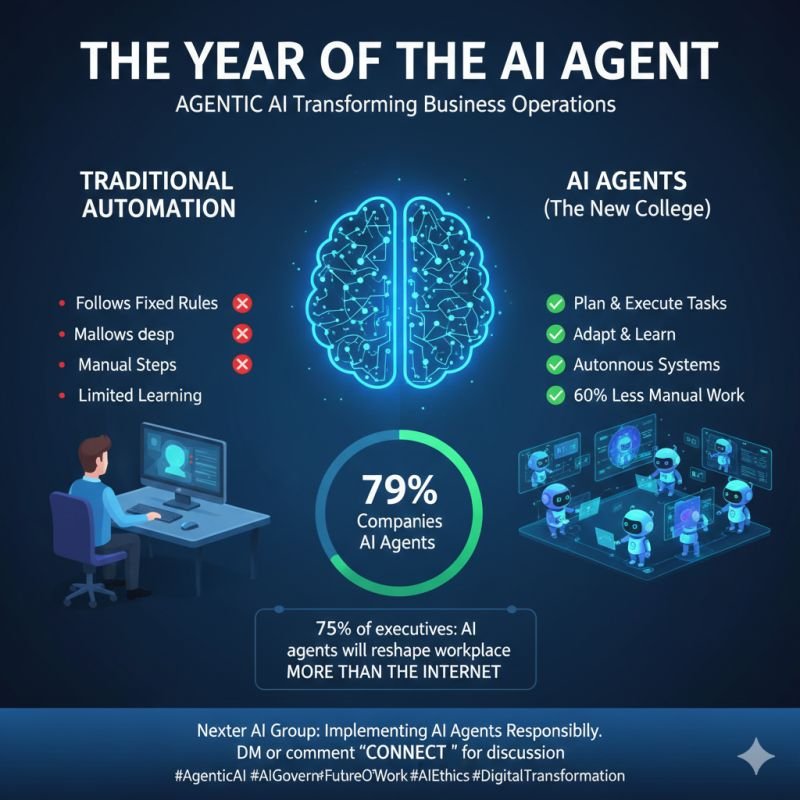
- Artificial Intelligence Is Entering a New Era
- From AI Assistants to AI Agents
- Why 2026 Represents a Turning Point
- What AI Agents Can Actually Do
- Productivity Is Only Part of the Story
- Autonomy Requires Governance
- Human Oversight Remains Essential
- Preparing Your Organisation for Agentic AI
- Final Thoughts
- References
Artificial Intelligence Is Entering a New Era
For the past few years, artificial intelligence has largely been used as an assistant.You ask a question.It generates an answer.You upload a document.It summarizes the content.You request an email.It drafts one.These capabilities have transformed productivity, but they remain fundamentally reactive.Now, a new generation of AI is emerging.
AI agents do not simply respond to prompts—they can plan, execute, monitor, and refine complex tasks with minimal human intervention.This shift may prove to be one of the most significant developments in enterprise technology since the rise of the internet.
From AI Assistants to AI Agents
Traditional AI assistants require continuous human direction.Every task begins with a prompt.Every step depends on user input.AI agents operate differently.Instead of completing isolated requests, they can pursue objectives across multiple steps while adapting to changing circumstances.
Depending on their design and governance, AI agents can:
- Break complex objectives into smaller tasks.
- Decide which actions should happen next.
- Access multiple business systems.
- Coordinate information across applications.
- Monitor progress.
- Escalate exceptions to human supervisors.
- Continuously improve through feedback.
Rather than functioning as software tools, AI agents increasingly resemble digital colleagues working alongside human teams.
Why 2026 Represents a Turning Point
Industry research suggests that organisations are rapidly moving from AI experimentation toward autonomous workflows.
Recent studies indicate:
- Nearly all organisations developing advanced AI applications are actively exploring AI agents.
- Most enterprises expect to increase investment in agentic AI over the coming year.
- Many businesses have already begun deploying AI agents in customer service, operations, software development, and knowledge work.
- Executives increasingly believe AI agents will reshape work more profoundly than previous waves of digital transformation.
The conversation is no longer about whether AI can generate text.It is about whether AI can execute entire business processes.
What AI Agents Can Actually Do
Unlike traditional automation, AI agents are designed to operate across connected workflows.
Examples include:
Customer Service
An AI agent can answer enquiries, verify customer information, schedule appointments, generate documentation, and escalate complex situations without requiring multiple human handoffs.
Legal Services
Within carefully governed environments, AI agents can:
- Review contracts.
- Perform legal research.
- Prepare document summaries.
- Track regulatory changes.
- Monitor deadlines.
- Assemble case materials for lawyer review.
Human lawyers continue making legal judgments while AI manages repetitive administrative work.
Business Operations
AI agents can coordinate:
- CRM updates
- Internal reporting
- Invoice processing
- Email management
- Project tracking
- Procurement workflows
Instead of automating individual tasks, they automate complete operational processes.
Productivity Is Only Part of the Story
Much of the discussion surrounding AI focuses on efficiency.The numbers are impressive.
Many organisations report:
- Faster workflow completion.
- Reduced manual workload.
- Improved operational consistency.
- Better employee productivity.
But efficiency is only the visible outcome.The larger transformation lies in organisational capacity.When professionals spend less time coordinating information, they gain more time for strategic thinking, client relationships, innovation, negotiation, and decision-making.AI agents create leverage rather than simply saving time.
Autonomy Requires Governance
As AI systems become more capable, governance becomes more important.The greater the autonomy of an AI agent, the greater the responsibility of the organisation deploying it.
Business leaders should ask critical questions before implementation:
- What decisions may AI make independently?
- Which decisions always require human approval?
- How are actions logged and audited?
- How is confidential information protected?
- What happens if the AI reaches the wrong conclusion?
- Who remains accountable for outcomes?
Technology without governance introduces operational risk.Governance without innovation limits competitive advantage.Successful organisations require both.
Human Oversight Remains Essential
Despite rapid advances, AI agents should not operate without appropriate supervision.Professional services—including legal, financial, healthcare, and consulting—depend on human judgment, ethics, and accountability.The most effective implementation model remains:
AI executes. Humans decide.AI agents gather information, perform analysis, and recommend actions.Professionals validate those recommendations, apply contextual judgment, and retain final responsibility.This human-in-the-loop approach balances efficiency with trust.
Preparing Your Organisation for Agentic AI
Adopting AI agents successfully requires more than purchasing software.
Organisations should prepare by:
- Identifying repetitive, rule-based workflows.
- Establishing clear governance policies.
- Defining human approval checkpoints.
- Training employees to collaborate with AI.
- Monitoring performance through measurable KPIs.
- Continuously reviewing security, compliance, and ethical considerations.
Technology implementation is only one part of transformation.Operational design determines long-term success.
Final Thoughts
Artificial intelligence is evolving from a productivity tool into an active participant in organisational workflows.This evolution will change how businesses operate, how professionals collaborate, and how services are delivered.The organisations that gain the greatest advantage will not necessarily deploy the most AI.They will deploy AI most responsibly.
The future is unlikely to belong to organisations where AI replaces people.It will belong to organisations where intelligent agents expand human capability while strong governance preserves accountability, transparency, and trust.The age of AI assistants is rapidly giving way to the age of AI agents.The question is no longer whether this transition will happen.
The question is whether your organisation is prepared to lead it.
References
- IBM. Global AI Developer Survey 2025.
- PwC. AI Jobs Barometer 2025.
- Boston Consulting Group (BCG). AI at Work: Agentic AI and Enterprise Transformation.
- ServiceNow. Enterprise AI Adoption Report 2025.
- Gartner. Top Strategic Technology Trends 2026.
- McKinsey & Company. The State of AI 2025.
- Deloitte. State of Generative AI in the Enterprise 2025.
- World Economic Forum. Future of Jobs Report 2025.
- Anthropic. Building Effective AI Agents.
- Microsoft. 2025 Work Trend Index.
- AI, Justice, and the Spirit of the Law: Why Human JudgmeAI, Justice, and the Spirit of the Law: Why Human Judgment Still Matters
- 2026: The Year Agentic AI Will Transform Legal Practice
- AI Governance Is Failing: Why Principles Alone Are No Longer Enough
- The 3.2-Hour Problem: How AI Is Transforming Contract Review Without Replacing Legal Judgment
- The Silent Revolution in Law Firms: Why AI Adoption Is Becoming a Competitive Advantage