- The World Is Looking at Iran Again. But It Should Remember What Happened Last Time.
- Investment Alone Could Not Reform the Economy
- The Problem Was Structural, Not Temporary
- Why 2026 Could Be Different
- Economic Governance Matters
- Building Rather Than Commenting
- The Opportunity Beneath the Headlines
- Open Iran Global
- Looking Beyond Sanctions
- Conclusion
- References
The World Is Looking at Iran Again. But It Should Remember What Happened Last Time.
In 2016, following the implementation of the Joint Comprehensive Plan of Action (JCPOA), international attention turned rapidly toward Iran.Business delegations arrived.Investment conferences multiplied.Global companies explored opportunities across energy, infrastructure, construction, technology, healthcare, and financial services.The optimism was genuine.So was the opportunity.I witnessed it firsthand while representing Open Iran Group.
There was no shortage of international interest.The shortage was institutional readiness.
Investment Alone Could Not Reform the Economy
Many observers assumed that sanctions relief would naturally produce economic liberalisation.It did not.Foreign businesses quickly encountered structural barriers that had existed long before sanctions.Opaque ownership structures.Regulatory uncertainty.Weak commercial enforcement.Limited competition.Most significantly, vast areas of the economy remained dominated by organisations operating beyond ordinary market competition.The challenge was never attracting foreign capital.
It was creating conditions in which capital could operate freely.Without structural reform, investment became constrained by the very institutions it was expected to transform.
The Problem Was Structural, Not Temporary
For years, I argued publicly that sanctions relief without economic reform would produce only limited and temporary results.The concern was not theoretical.Many strategically important sectors—including construction, infrastructure, logistics, energy, telecommunications, and heavy industry—remained heavily influenced by entities linked to the Islamic Revolutionary Guard Corps (IRGC).For many foreign investors, entering the Iranian market meant navigating commercial relationships that were neither transparent nor genuinely competitive.Investment became possible.Open competition remained considerably more difficult.
The result was predictable.International enthusiasm gradually declined.Many projects stalled.Confidence weakened.By 2018, much of the momentum that had characterised the post-JCPOA period had disappeared.
Why 2026 Could Be Different
The ceasefire Memorandum of Understanding signed in June 2026 has once again generated discussion about Iran’s economic future.History, however, offers an important lesson.Sanctions relief alone does not create an open economy.Removing external restrictions is only one part of economic transformation.The more difficult task is building institutions capable of supporting competitive markets.
That requires:
- transparent investment rules;
- independent commercial courts;
- enforceable contracts;
- regulatory certainty;
- genuine competition;
- effective corporate governance;
- confidence that private enterprise—not political influence—determines commercial success.
Without these foundations, investment risks repeating the cycle witnessed after 2016.
Economic Governance Matters
Modern economies depend upon trust.Investors evaluate far more than tax rates or market size.They assess legal certainty.Contract enforcement.Corporate transparency.Regulatory independence.Political stability.Artificial intelligence, digital infrastructure, advanced manufacturing, renewable energy, and international finance all require predictable governance environments.Capital follows confidence.
Confidence follows institutions.This is why economic reform is ultimately a governance challenge as much as an economic one.
Building Rather Than Commenting
Following my departure from Iran in 2018, my work increasingly focused on international law, AI governance, regulatory frameworks, and legal innovation.Those years were not spent waiting.They were spent preparing.The experience gained through advising organisations on AI governance, the EU AI Act, emerging regulatory systems, and international legal frameworks has reinforced a lesson that applies equally to national economies.
Sustainable development depends less on opportunity than on governance.Technology alone cannot compensate for weak institutions.Neither can investment.
The Opportunity Beneath the Headlines
Despite the challenges, I remain optimistic about Iran’s long-term potential.
Few countries possess such a combination of:
- strategic geographic location;
- highly educated human capital;
- abundant natural resources;
- entrepreneurial talent;
- industrial capacity;
- and access to regional markets.
These strengths have existed for decades.Unlocking them requires institutions capable of supporting open competition rather than limiting it.A genuinely open Iranian economy would not benefit only Iran.
It would reshape regional trade, investment, technology partnerships, logistics, and infrastructure development across the Middle East and beyond.
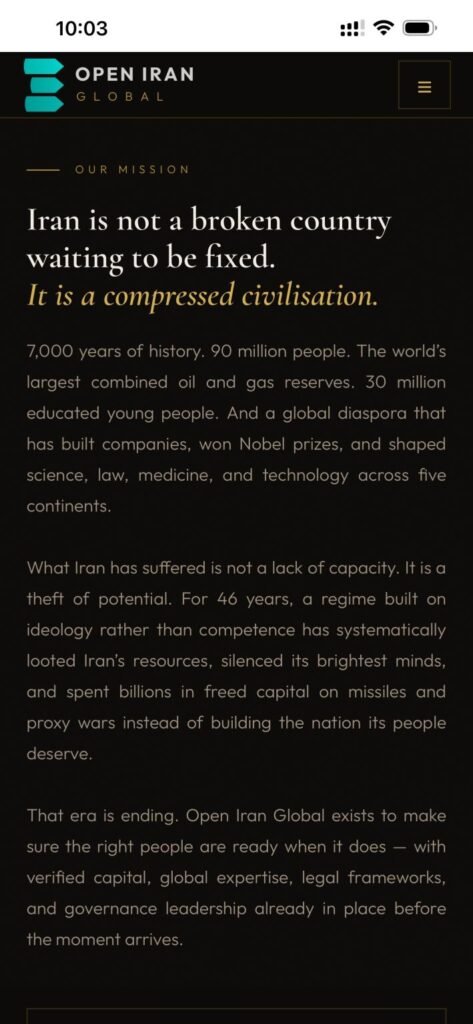
Open Iran Global
The re-establishment of Open Iran Global reflects this belief.Its purpose is not merely to discuss Iran’s future.It is to help prepare for it.Responsible investment requires more than capital.It requires legal expertise.Trusted governance.International standards.Verified professional networks.Transparent commercial relationships.The objective is not simply increasing investment.It is helping create the institutional conditions under which investment benefits society rather than reinforcing existing structural problems.
Looking Beyond Sanctions
Too often, international discussion treats sanctions relief as the finish line.It is not.It is only the beginning.Economic openness depends upon much more than removing restrictions.It depends upon building legal institutions capable of protecting competition, enforcing contracts, attracting responsible investment, and maintaining public confidence.History has already demonstrated what happens when those foundations are missing.
The next chapter does not need to repeat the last one.
Conclusion
Iran stands at another important historical moment.The international community will understandably focus on sanctions, diplomacy, and investment opportunities.Those issues matter.But lasting economic transformation will ultimately depend on governance rather than geopolitics.Open markets require open institutions.Investment requires trust.Growth requires accountability.The future of Iran will not be determined solely by how much capital enters the country.It will be determined by whether the legal and institutional framework allows that capital to create broad-based prosperity rather than concentrated control.The opportunity is significant.The responsibility is even greater.
References
- Joint Comprehensive Plan of Action (JCPOA), 2015.
- Reuters reporting on Iran’s economy, sanctions relief, and commercial developments.
- Iran’s Foreign Investment Promotion and Protection Act (FIPPA).
- World Bank reports on Iran’s investment climate and governance.
- OECD Principles of Corporate Governance.
- United Nations Conference on Trade and Development (UNCTAD) – Investment Policy Framework for Sustainable Development.
- AI Adoption Starts with Trust, Not Technology
- Why AI Adoption Fails in Law Firms: The Middle Management Bottleneck
- The Leadership Gap: Why AI Resistance at the Top Puts Law Firms at Risk
- The AI Copyright Reckoning: Who Owns Creativity in the Age of Generative AI?
- AI Hallucinations Are No Longer a New Problem. They Are Becoming a Professional Responsibility Problem.