- When AI Fails, Everyone Has an Explanation.
- The E-Discovery Scenario
- The Accountability Vacuum
- AI Does Not Come With Liability
- The Contract Decides Before the Failure Happens
- Questions Every Firm Should Ask
- Governance Begins With Procurement
- Trust Requires Shared Responsibility
- From AI Governance to Contract Governance
- Conclusion
- References
When AI Fails, Everyone Has an Explanation.
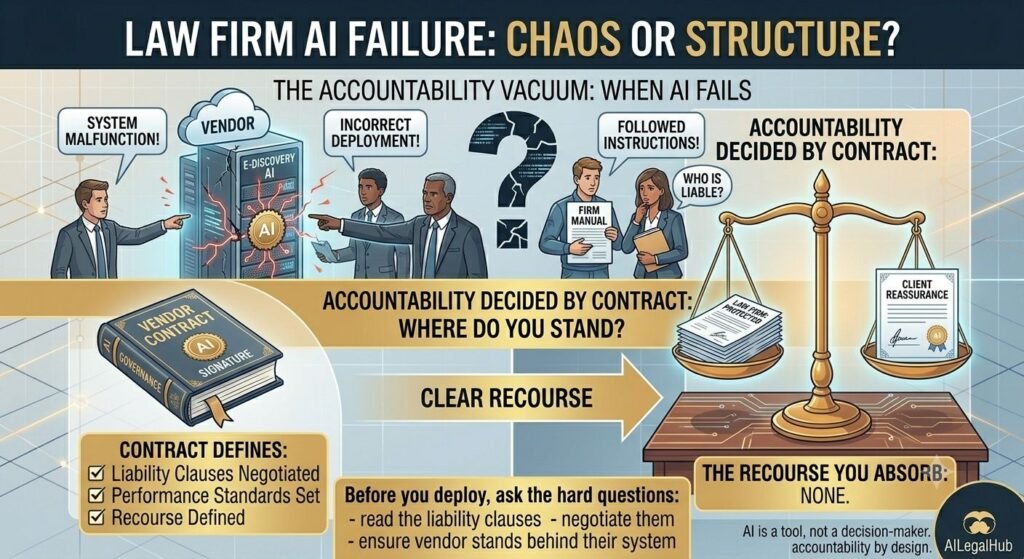
The vendor blames the law firm.The law firm blames the software.The litigation team says they followed the instructions.
The client simply asks:
“Who is responsible?”This is becoming one of the defining legal governance questions of artificial intelligence.
Not whether AI makes mistakes.Every technology does.The real question is what happens after the mistake.Because accountability does not emerge automatically.It must be designed.
And, in commercial relationships, it is usually designed through contract.
The E-Discovery Scenario
Imagine a law firm deploying an AI-powered e-discovery platform.The system reviews millions of documents, identifies relevant evidence, and excludes material it considers irrelevant.The litigation team follows the recommended workflow.No warning appears.No technical errors are reported.Months later, critical documents are discovered that should have been disclosed.The omission damages the client’s case.Immediately, responsibility becomes blurred.
The vendor argues that the firm’s lawyers should have independently verified the output.The law firm argues that it relied on software marketed as accurate and reliable.The litigation support team explains that they followed every published instruction.Meanwhile, the client suffers the consequences.
This is not simply a technical failure.It is a governance failure.
The Accountability Vacuum
Artificial intelligence introduces an unusual legal problem.Responsibility becomes distributed across multiple actors.The developer builds the system.The vendor licenses it.The law firm deploys it.The lawyer supervises it.The client relies upon it.When everything works, this distribution appears efficient.
When something goes wrong, every participant points elsewhere.The result is what I describe as an accountability vacuum—a situation where responsibility becomes difficult to locate precisely when it matters most.
AI Does Not Come With Liability
Many firms devote significant attention to selecting AI technology.They evaluate functionality.Accuracy.User experience.Integration.Security.Much less attention is often given to the contract governing the relationship.That omission can become extremely expensive.Artificial intelligence does not arrive with built-in legal responsibility.It arrives with licence agreements.Terms of service.Warranty exclusions.Liability limitations.Indemnity clauses.
These documents—not the software itself—often determine who ultimately bears the financial consequences of failure.
The Contract Decides Before the Failure Happens
Most vendor agreements are drafted to minimise the vendor’s exposure.Limitation-of-liability clauses frequently cap damages at the value of the software subscription.Warranty disclaimers often state that outputs are provided “as is.”Many contracts explicitly require customers to independently verify all AI-generated results.From the vendor’s perspective, these provisions are commercially understandable.
From the law firm’s perspective, they can create significant governance risk.The contract often determines responsibility long before the first mistake occurs.By the time litigation begins, the allocation of risk has usually already been agreed.
Questions Every Firm Should Ask
Before deploying AI in high-risk legal work, firms should carefully examine several contractual issues.Who bears responsibility if the system produces inaccurate results?How is acceptable performance defined?Are service-level obligations measurable?Does the vendor provide warranties regarding accuracy or reliability?
Are there indemnities for regulatory violations or intellectual property claims?What audit rights exist?Can the firm independently investigate how the system reached its conclusions?Perhaps most importantly:Who absorbs the loss if AI contributes to professional negligence?
If the contract does not clearly answer these questions, the default answer may be the law firm itself.
Governance Begins With Procurement
Artificial intelligence governance is often discussed in terms of ethics, compliance, and regulation.Those discussions are essential.But governance also begins much earlier.It begins during procurement.Choosing an AI system is not merely a technology decision.It is a legal risk allocation decision.
Every procurement process should therefore involve not only technical evaluation but legal review.Law firms routinely negotiate complex commercial contracts on behalf of clients.They should apply the same level of scrutiny when purchasing AI systems for their own practice.
Trust Requires Shared Responsibility
Responsible vendors should be willing to discuss accountability openly.No AI system can guarantee perfection.
But trustworthy providers should be prepared to explain:
- how the system is tested;
- how errors are monitored;
- what performance standards exist;
- how incidents are investigated;
- and where responsibility is shared.
If a vendor refuses meaningful discussion of accountability, firms should ask an important question.If the developer lacks confidence in standing behind the product, why should lawyers place their professional reputation behind it?
From AI Governance to Contract Governance
The future of AI governance will not be shaped solely by legislation.It will also be shaped by contracts.Every AI deployment creates a network of legal relationships between developers, vendors, professional users, regulators, insurers, and clients.Those relationships require clear allocation of rights and responsibilities.Without contractual clarity, sophisticated technology can quickly become sophisticated uncertainty.
The stronger the AI becomes, the more important contractual governance becomes alongside technical governance.
Conclusion
Artificial intelligence is transforming legal practice.It is accelerating research, improving document review, enhancing litigation support, and increasing operational efficiency.Yet every technological benefit carries legal responsibility.When AI fails, responsibility should not become a game of institutional finger-pointing.It should already be defined.Law firms often spend months evaluating software features.They sometimes spend only hours reviewing the contract governing those features.That balance should be reversed.Technology creates capability.Contracts allocate accountability.And in legal practice, accountability is every bit as important as innovation.
References
- American Bar Association. Formal Opinion 512: Generative Artificial Intelligence Tools (2024).
- European Union. Regulation (EU) 2024/1689 – Artificial Intelligence Act.
- National Institute of Standards and Technology (NIST). AI Risk Management Framework.
- OECD. OECD AI Principles.
- International Organization for Standardization. ISO/IEC 42001: Artificial Intelligence Management Systems.
- European Commission. Ethics Guidelines for Trustworthy AI.
- Goudarzi, S. AI for Legal Professionals.
- Goudarzi, S. The Quantum Guardian.
- AI Adoption Starts with Trust, Not Technology
- Why AI Adoption Fails in Law Firms: The Middle Management Bottleneck
- The Leadership Gap: Why AI Resistance at the Top Puts Law Firms at Risk
- The AI Copyright Reckoning: Who Owns Creativity in the Age of Generative AI?
- AI Hallucinations Are No Longer a New Problem. They Are Becoming a Professional Responsibility Problem.