- The Evidence Problem Is Changing
- Deepfakes Are Only Part of the Problem
- Why This Matters for Litigation
- Authenticity Is Becoming a Legal Issue
- The Role of AI Verification
- What Law Firms Should Start Doing
- The Courtroom Is Becoming an Information-Integrity Environment
- The New Question for Lawyers
- The Bigger Governance Question
- Conclusion
Artificial intelligence is changing the courtroom in a way that goes beyond legal research, document drafting, or case preparation.It is changing the evidence itself.
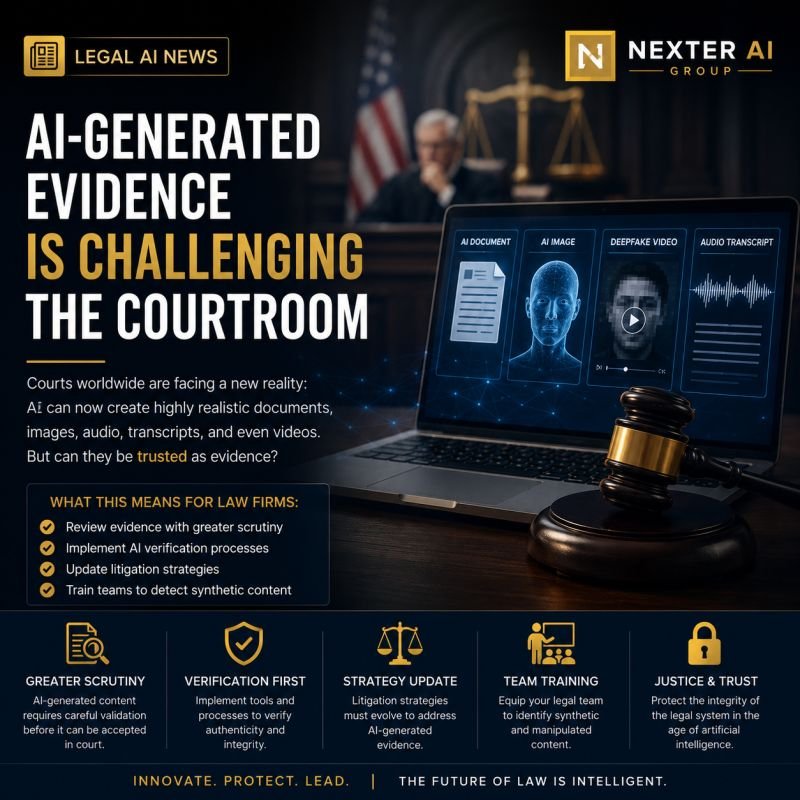
Documents can now be generated by AI. Transcripts can be synthetically produced. Images can be manipulated. Voices can be cloned. Videos can be created in which a person appears to say or do something that never happened.
This creates a fundamental problem for the justice system:How do we know that the evidence presented to a court is authentic?
For centuries, courts have developed rules and procedures for assessing evidence. Lawyers challenge witnesses. Documents can be examined. Physical evidence can be inspected. Digital evidence can be traced to its source.Generative AI complicates every one of these assumptions.
The Evidence Problem Is Changing
The legal profession has traditionally focused on whether evidence is relevant, admissible, and reliable.
AI introduces another question:Was this evidence actually created by the person, event, or system it appears to represent?
Consider a video submitted during litigation.It appears to show a person making a statement.The image looks realistic.The voice sounds authentic.The context appears consistent with the surrounding evidence.But the entire video may have been synthetically generated.
Without appropriate verification, something that looks like evidence may actually be manufactured content.This is the growing challenge of synthetic media.
Deepfakes Are Only Part of the Problem
When people discuss AI-generated evidence, deepfake videos often receive the most attention.But the problem is broader.
AI can potentially generate or manipulate:
- photographs;
- videos;
- audio recordings;
- transcripts;
- emails;
- documents;
- screenshots;
- social-media content;
- digital records;
- and other forms of apparently authentic information.
The challenge for courts is therefore not simply detecting deepfakes.
It is establishing provenance, authenticity, and reliability across increasingly sophisticated forms of digital evidence.
Why This Matters for Litigation
Litigation depends on evidence.A lawyer may build an argument around a document.A witness may be confronted with an audio recording.A court may be asked to consider a photograph.
An opposing party may present a video as proof of an event.If the underlying material has been manipulated or entirely generated by AI, the consequences can be significant.
A fabricated piece of evidence could influence:
Case strategy.
Settlement decisions.
Witness credibility assessments.
Court findings.
Damages calculations.
And ultimately, the outcome of a dispute.The problem is particularly serious because synthetic content does not necessarily look suspicious.The technology is becoming better at producing material that appears authentic.
Authenticity Is Becoming a Legal Issue
This means verification can no longer be treated purely as a technical function.It is becoming part of litigation strategy.
Law firms need to consider questions such as:
Where did this evidence originate?
Who created it?
Has the original file been preserved?
Has the evidence been altered?
Can its metadata be verified?
Is there a reliable chain of custody?
Has the material been processed by an AI system?
Can independent technical analysis establish authenticity?
These questions may become increasingly important before evidence ever reaches the courtroom.
The Role of AI Verification
The obvious response is to use AI to detect AI.That may become part of the solution.Verification systems can potentially help identify synthetic or manipulated content and flag anomalies that may not be obvious to a human reviewer.But there is an important limitation.
AI detection itself cannot automatically be treated as infallible.
A system designed to detect manipulated content can itself produce false positives or false negatives.That means the legal profession should avoid replacing one black box with another.The goal should be a layered verification process involving technology, human expertise, documentation, and appropriate legal scrutiny.
What Law Firms Should Start Doing
Law firms involved in litigation should begin considering how AI-generated evidence affects their existing processes.
1. Increase evidence scrutiny
Digital evidence should not automatically be treated as authentic simply because it appears realistic.
2. Preserve original evidence
Where possible, firms should preserve original files and relevant metadata rather than relying only on screenshots, edited copies, or converted formats.
3. Establish verification procedures
Firms should develop processes for assessing potentially synthetic or manipulated evidence.
4. Train litigation teams
Lawyers and support staff increasingly need to recognise the characteristics and risks associated with synthetic media.
5. Update litigation strategy
Evidence challenges may increasingly involve questions of AI generation, manipulation, provenance, and technical authenticity.
6. Maintain human judgment
Technology should support evidence assessment, not replace the lawyer’s responsibility to evaluate the reliability and legal significance of evidence.
The Courtroom Is Becoming an Information-Integrity Environment
There is a deeper issue here.Historically, the legal system operated on the assumption that most evidence was fundamentally tied to something that happened in the physical world.A photograph represented something that a camera captured.A recording represented something that someone said.A document represented something that someone wrote.That assumption is becoming weaker.
AI makes it possible to create convincing representations without the underlying event ever occurring.This changes the relationship between appearance and reality.
And law depends heavily on that relationship.
The New Question for Lawyers
The question is no longer simply:
“Is this evidence relevant?”
Increasingly, lawyers may also need to ask:
“Can we establish that this evidence is what it claims to be?”
That is a fundamentally different problem.It requires lawyers to work across legal and technical disciplines.
Litigators may need to understand concepts such as:
- synthetic media;
- digital provenance;
- metadata;
- content authentication;
- forensic verification;
- AI-generated content;
- and manipulation detection.
Not because every lawyer needs to become a forensic technologist.But because lawyers need to understand the risks well enough to know when specialist expertise is required.
The Bigger Governance Question
AI-generated evidence also exposes a broader issue in AI governance.If technology makes it increasingly easy to manufacture convincing information, then trust cannot depend solely on what something looks like.We need systems that make authenticity easier to establish.
That means thinking about:
Provenance.
Transparency.
Verification.
Accountability.
Chain of custody.
And ultimately, trust.
The legal system cannot afford to treat these as purely technical concerns.They go directly to the integrity of adjudication.
Conclusion
AI is not simply changing how lawyers work.It is beginning to change the nature of the material lawyers work with.The courtroom of the future may contain evidence that was written, recorded, photographed, edited, or entirely generated by artificial intelligence.The challenge will not be to reject that technology.It will be to develop reliable ways of distinguishing authentic evidence from convincing fabrication.Law firms that prepare for this shift will be better positioned to protect their clients, challenge unreliable evidence, and preserve the integrity of litigation.Because as AI becomes better at creating things that look real, the legal profession will need to become much better at proving what is real.The courtroom is changing.The question is whether our standards of evidence can change with it.
- AI Adoption Starts with Trust, Not Technology
- Why AI Adoption Fails in Law Firms: The Middle Management Bottleneck
- The Leadership Gap: Why AI Resistance at the Top Puts Law Firms at Risk
- The AI Copyright Reckoning: Who Owns Creativity in the Age of Generative AI?
- AI Hallucinations Are No Longer a New Problem. They Are Becoming a Professional Responsibility Problem.