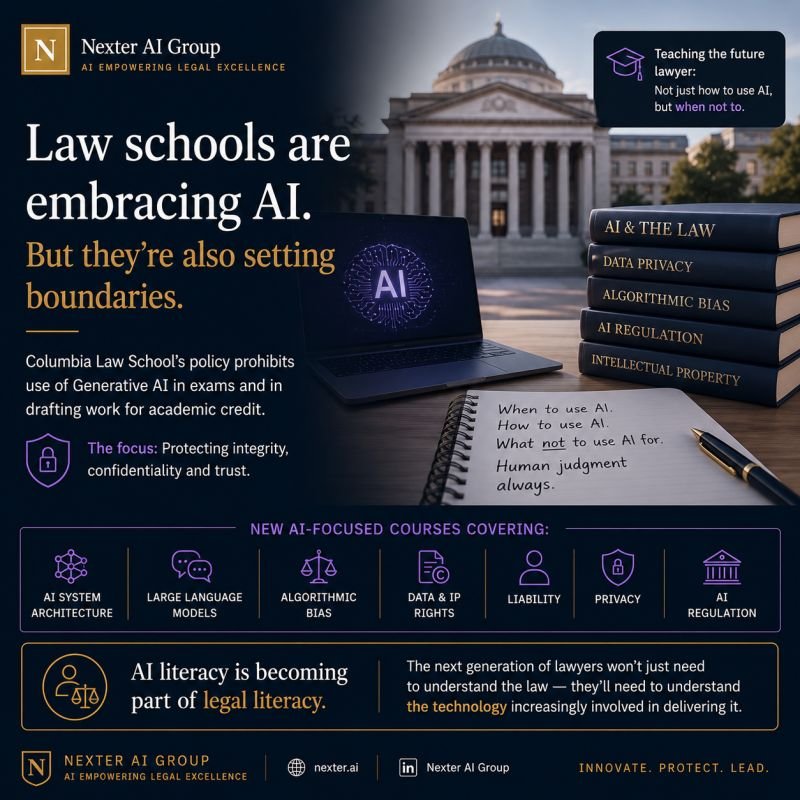
Law schools are starting to teach AI.At the same time, they are increasingly teaching students when not to use it.That tension may be one of the most important developments in legal education.
The Paradox of AI in Legal Education
Consider Columbia Law School’s approach to generative AI.Its policy places restrictions on the use of AI in examinations and in work submitted for academic credit, while allowing certain uses such as studying, brainstorming, and identifying typographical errors.The policy also highlights an issue that extends far beyond academic integrity: the protection of confidential and personal information.At the same time, legal education is expanding its focus on AI itself.
Students are increasingly being exposed to subjects including:
- AI system architecture
- Large language models
- Algorithmic bias
- Data and intellectual property rights
- AI liability
- Privacy
- AI regulation
And this creates an interesting paradox.Future lawyers need to understand AI deeply while also learning when they should not use it.That is not contradictory.
It is precisely what AI literacy should mean.
AI Literacy Is Not “Knowing ChatGPT”
There is a tendency to define AI literacy too narrowly.Can you write a prompt?Can you generate a document?Can you summarise a case?Can you use an AI research tool?Those skills matter.But they are only the beginning.
For a lawyer, meaningful AI literacy means understanding:When to use AI.How to use it.What information can safely be provided.What information should never be provided.How to verify the output.What risks the system introduces.When human judgment must take over.The most AI-literate lawyer may therefore be the lawyer who knows when to close the AI window.
The Skill Is Judgment
This distinction matters because AI can make inappropriate use look remarkably efficient.A lawyer may be able to generate a 20-page document in seconds.That does not mean the document should have been generated that way.A system may be capable of analysing confidential information.That does not automatically mean it should receive that information.
An AI tool may produce a persuasive legal argument.That does not mean the argument is legally correct.The critical skill is therefore not maximum AI utilisation.It is appropriate AI utilisation.
The question changes from:”How can I use AI for this?”
to:”Should AI be involved in this at all?”
That is a much more sophisticated question.
The Law School Lesson Applies to Law Firms
The same principle should govern professional practice.A law firm cannot simply give everyone access to an AI tool and call that an AI strategy.It needs rules.It needs governance.It needs training.And, importantly, it needs boundaries.A responsible firm’s AI policy should help lawyers understand different categories of use.
Low-risk uses
Certain activities may be suitable for AI assistance with appropriate controls:
- brainstorming;
- formatting;
- summarisation of appropriate non-confidential material;
- drafting internal content;
- identifying obvious errors.
Higher-risk uses
Other activities require substantially greater caution:
- legal research;
- client-specific advice;
- analysis of confidential documents;
- litigation strategy;
- automated decision-making;
- handling sensitive personal information.
The point is not that AI should never be used for high-risk work.The point is that risk should determine the level of oversight.
The Lawyer Still Owns the Judgment
This may be the most important principle.
If an AI system produces an incorrect citation, the lawyer cannot tell a court:“The AI gave it to me.”
If an AI-generated contract contains a critical error, responsibility does not automatically transfer to the software vendor.If confidential client information is improperly disclosed through an AI system, the fact that the system made the disclosure does not eliminate the professional responsibility surrounding the decision to use it.AI can assist professional judgment.It does not automatically assume professional responsibility.
That distinction needs to become part of legal education from the beginning.
The Future Lawyer Will Need Two Forms of Literacy
The traditional lawyer needs legal literacy.The emerging lawyer needs something more.
Legal literacy + AI literacy.
But AI literacy should not be understood as technical expertise alone.A lawyer does not necessarily need to become a machine-learning engineer.
They do need to understand enough about AI to recognise its:
- capabilities;
- limitations;
- failure modes;
- data requirements;
- confidentiality implications;
- reliability problems;
- governance requirements;
- and appropriate boundaries.
In other words:
The future lawyer needs to understand not only what AI can do, but what it should be allowed to do.
AI Judgment Will Become a Professional Skill
This is where I think legal education is heading.The lawyers entering practice over the next decade will likely encounter AI throughout their professional lives.They will use AI for research.They will encounter AI-generated evidence.They will advise clients deploying AI.They will negotiate contracts involving AI systems.
They will deal with AI-related liability.They will encounter questions surrounding privacy, intellectual property, discrimination, explainability and accountability.Eventually, understanding AI will not be a specialist advantage.It will be part of competent professional practice.But competence will not mean using AI everywhere.
It will mean knowing where the boundaries are.
The Real Question for Law Schools
So perhaps the debate should not be:“Should law schools teach students how to use AI?”
Of course they should.But that is only half the curriculum.
The more important question is:“Should law schools teach students how to exercise judgment about AI?”
Absolutely.Because the lawyer of the future should not be the person who asks AI to make every decision.
It should be the person who understands:when AI adds value,when AI introduces risk,when AI requires verification,and when the machine needs to step aside.
AI literacy is becoming part of legal literacy.
But the ultimate professional skill will remain what it has always been:judgment.
- AI Adoption Starts with Trust, Not Technology
- Why AI Adoption Fails in Law Firms: The Middle Management Bottleneck
- The Leadership Gap: Why AI Resistance at the Top Puts Law Firms at Risk
- The AI Copyright Reckoning: Who Owns Creativity in the Age of Generative AI?
- AI Hallucinations Are No Longer a New Problem. They Are Becoming a Professional Responsibility Problem.