The Algorithm Was Right. The Advice Was Wrong.
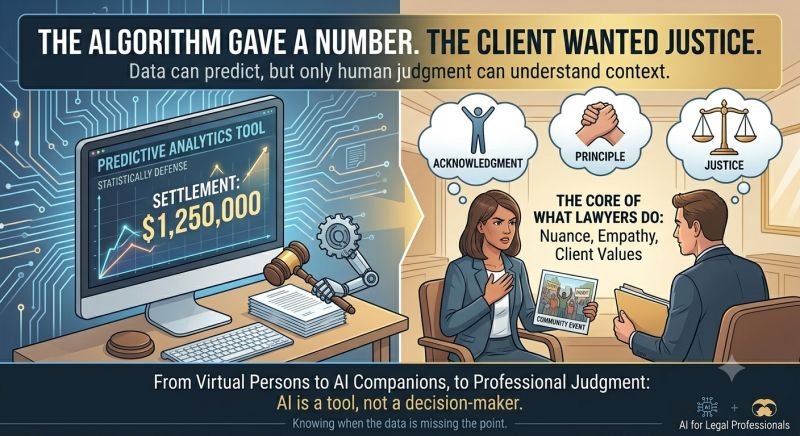
The settlement figure looked perfect.A litigation analytics platform had analysed thousands of comparable disputes. It evaluated precedents, claim values, judicial tendencies, jurisdictional data, settlement history, and litigation costs. The recommendation it produced was statistically sound.On paper, it was difficult to challenge.Yet the client rejected it immediately.Not because the number was inaccurate.Because the number answered the wrong question.
For the client, the dispute had never been about money.After three years of litigation, the case had become about recognition, accountability, and being heard. Accepting a settlement—even a financially favourable one—felt like abandoning the principle that motivated the claim in the first place.The algorithm could calculate value.It could not understand meaning.
That distinction reveals one of the most important limitations of artificial intelligence in legal practice.
Prediction Is Not Judgment
Artificial intelligence excels at identifying patterns.
Modern legal AI systems can:
- analyse thousands of judicial decisions within minutes;
- estimate litigation outcomes;
- identify relevant precedents;
- detect contractual risks;
- calculate likely settlement ranges;
- predict procedural timelines.
These capabilities are transforming legal practice.They improve efficiency.They reduce repetitive work.They provide lawyers with valuable insights that would previously have required days of research.But prediction and judgment are not the same thing.
Prediction answers:
What is likely to happen?
Judgment asks:
What should we do?
Those are fundamentally different questions.
Law Is More Than Pattern Recognition
Legal reasoning is often described as applying rules to facts.In reality, it is considerably more complex.Lawyers constantly weigh competing interests that cannot be reduced to statistical variables.A client’s personal values.Commercial relationships.Public reputation.Political consequences.Long-term business strategy.Family dynamics.Future negotiations.None of these factors fit neatly into historical datasets.Two legally identical cases may require completely different advice because the people involved value entirely different outcomes.The law provides options.Judgment determines which option serves the client best.
What AI Cannot Measure
Artificial intelligence processes observable information remarkably well.It struggles with meaning.It cannot genuinely understand why one client would rather lose in court than settle.Why another values confidentiality more than compensation.Why preserving a business relationship matters more than maximising damages.Or why a public judgment may be worth far more than a private agreement.These are not unusual situations.
They are everyday realities of legal practice.Clients rarely seek lawyers simply to discover what the law says.They seek lawyers because they need help deciding what to do.
The Human Dimension of Legal Advice
Throughout legal history, the most difficult cases have rarely involved uncertain law.More often, the law was relatively clear.The challenge lay in applying it wisely.Good legal judgment requires balancing competing values.
It requires recognising when strict legal correctness produces an outcome that is commercially, ethically, or personally undesirable.It requires listening.Interpreting.Negotiating.Understanding not only the legal problem but the human circumstances surrounding it.
These qualities cannot be derived solely from historical data.
AI as an Augmentation Tool
None of this diminishes AI’s value.On the contrary, responsible use of AI can significantly improve legal services.
Artificial intelligence can:
- accelerate legal research;
- identify overlooked precedents;
- summarise evidence;
- highlight contractual inconsistencies;
- support litigation strategy;
- model different legal scenarios.
Used appropriately, AI expands a lawyer’s analytical capacity.It allows professionals to spend less time searching for information and more time interpreting it.The objective is not replacing lawyers.It is enhancing the quality of their judgment.
Governance Requires Human Responsibility
This distinction also carries important governance implications.Professional responsibility cannot be delegated to algorithms.The EU AI Act, professional conduct rules, and emerging AI governance frameworks all reinforce the principle that meaningful human oversight remains essential where AI supports decisions with significant legal consequences.Lawyers remain accountable not because they possess faster pattern recognition than machines.
They remain accountable because they exercise judgment.AI may recommend.The lawyer decides.
That allocation of responsibility is fundamental to professional ethics.
Judgment Is the Competitive Advantage
As AI becomes increasingly capable, legal research and document drafting will become more accessible.The competitive advantage of lawyers will shift.Not toward performing routine tasks faster.But toward exercising better judgment.The lawyers who thrive will not be those who unquestioningly follow AI recommendations.Nor will they be those who reject AI entirely.
They will be those who know when data deserves confidence—and when it fails to capture what matters most.Because clients do not hire lawyers simply for information.They hire them for judgment.
Conclusion
Artificial intelligence is becoming exceptionally good at answering questions about probability.Lawyers are still responsible for answering questions about purpose.A settlement may be statistically optimal.A contract may appear commercially efficient.A legal strategy may maximise the probability of success.Yet none of those answers determines whether they are right for a particular client.The future of legal practice will not belong to lawyers who compete with AI at analysing data.It will belong to lawyers who combine AI’s analytical power with the distinctly human capacities that no algorithm can replicate—judgment, empathy, wisdom, and responsibility.In law, the most important decision is rarely the one with the highest probability.It is the one that best serves the human being sitting across the table.
References
- European Union. Regulation (EU) 2024/1689 – Artificial Intelligence Act.
- American Bar Association. Formal Opinion 512: Generative Artificial Intelligence Tools (2024).
- UNESCO. Recommendation on the Ethics of Artificial Intelligence (2021).
- OECD. OECD AI Principles.
- Daniel Kahneman. Thinking, Fast and Slow.
- Richard Susskind. Tomorrow’s Lawyers.
- Goudarzi, S. AI for Legal Professionals.
- Goudarzi, S. The Quantum Guardian.
- AI Adoption Starts with Trust, Not Technology
- Why AI Adoption Fails in Law Firms: The Middle Management Bottleneck
- The Leadership Gap: Why AI Resistance at the Top Puts Law Firms at Risk
- The AI Copyright Reckoning: Who Owns Creativity in the Age of Generative AI?
- AI Hallucinations Are No Longer a New Problem. They Are Becoming a Professional Responsibility Problem.