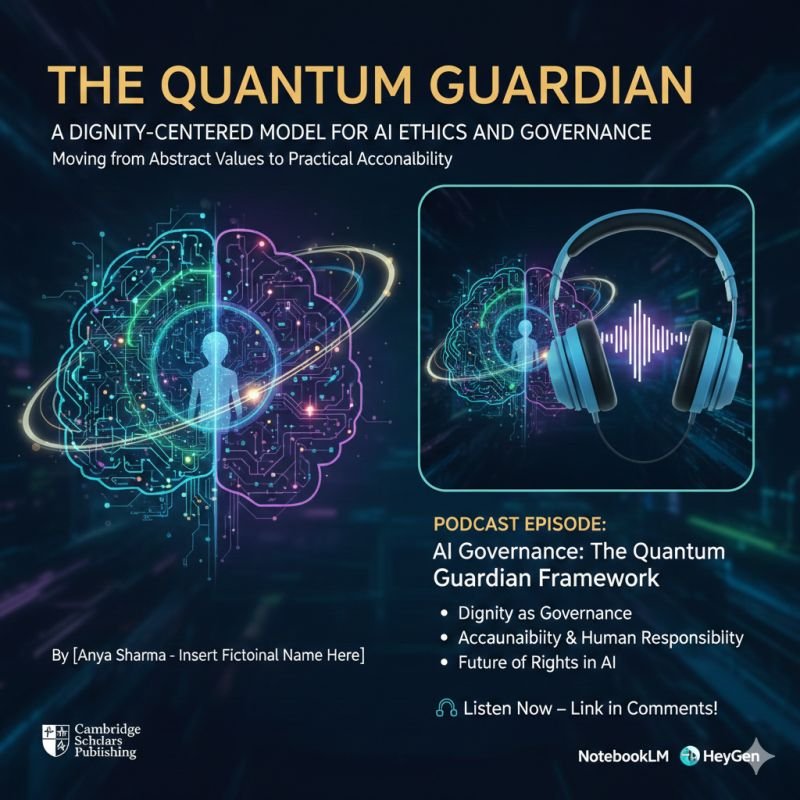
- Artificial Intelligence Does Not Have an Ethics Problem
- The Governance Gap
- Ethics Without Enforcement Changes Very Little
- Why Human Dignity Must Become Operational
- Governance Is Becoming a Business Requirement
- Moving Beyond Checklists
- Accountability Must Be Designed Into AI
- The Future of AI Governance
- Final Thoughts
- References
Artificial Intelligence Does Not Have an Ethics Problem
Artificial intelligence has no shortage of ethical principles.Governments publish them.Universities debate them.Technology companies promote them.International organisations issue new frameworks almost every year.Fairness.Transparency.Accountability.Privacy.Human oversight.Trustworthiness.
The problem is not that we lack principles.
The problem is that principles rarely change behaviour.An AI system does not become responsible simply because its documentation includes the word “ethical.”Organisations do not become accountable simply because they publish responsible AI guidelines.
The gap between ethical aspiration and operational reality remains one of the greatest challenges in AI governance today.
The Governance Gap
Over the past few years, AI governance has become one of the fastest-growing areas of policy discussion.The EU AI Act.The OECD AI Principles.UNESCO’s Recommendation on the Ethics of Artificial Intelligence.
The NIST AI Risk Management Framework.Together, these initiatives have established an important foundation.Yet most organisations still struggle with practical implementation.
Questions repeatedly emerge:
- Who is accountable when an AI system causes harm?
- How should human oversight actually operate?
- Which decisions should never be delegated to AI?
- How should organisations balance efficiency with human dignity?
- What evidence demonstrates that AI governance is actually working?
Policies often describe desirable outcomes.Far fewer explain how those outcomes should be achieved.
Ethics Without Enforcement Changes Very Little
Many AI governance frameworks rely heavily on voluntary compliance.They encourage organisations to behave responsibly.They recommend transparency.They promote fairness.These principles are valuable.
But principles without accountability frequently become corporate aspirations rather than operational requirements.History demonstrates this pattern repeatedly.Corporate governance.Environmental regulation.Data protection.Cybersecurity.
Meaningful progress occurred only when governance evolved beyond recommendations toward measurable obligations, independent oversight, and enforceable accountability.AI is unlikely to be different.
Why Human Dignity Must Become Operational
Discussions about AI ethics frequently describe human dignity as a core value.Yet dignity is often treated as an abstract philosophical concept rather than a practical governance principle.A governance framework centred on dignity asks different questions.Instead of asking only:
“Can AI make this decision?”
It asks:
“Should AI make this decision?”
It considers:
- Individual autonomy.
- Human agency.
- Meaningful consent.
- Fair treatment.
- Explainability.
- Rights protection.
- Professional accountability.
Dignity becomes something organisations actively preserve through system design—not merely something they reference in policy documents.
Governance Is Becoming a Business Requirement
AI governance is no longer solely a legal or ethical concern.It has become a strategic business issue.Organisations deploying AI increasingly face expectations from regulators, clients, investors, employees, and the public.
Responsible AI now influences:
- Corporate reputation.
- Regulatory compliance.
- Procurement decisions.
- Client trust.
- Investment risk.
- Long-term competitive advantage.
Businesses that treat governance as an afterthought may discover that technical capability alone is insufficient.Trust has become part of organisational infrastructure.
Moving Beyond Checklists
Many organisations approach AI governance through compliance checklists.Risk assessments.Documentation.Policies.Approval processes.These remain important.But governance should not become a paperwork exercise.Effective governance is embedded throughout the AI lifecycle.
It influences:
- System design.
- Model selection.
- Data quality.
- Human oversight.
- Decision authority.
- Continuous monitoring.
- Incident response.
- Organisational learning.
Governance should actively shape how AI operates—not simply document how it was deployed.
Accountability Must Be Designed Into AI
One of the defining questions of the AI era is responsibility.If an autonomous system makes a harmful recommendation…
Who answers?
The software developer?
The organisation deploying the system?
The executive approving implementation?
The professional relying upon its output?
Without clearly defined accountability structures, responsibility becomes increasingly difficult to assign as AI systems gain greater autonomy.Governance therefore requires more than technical safeguards.It requires organisational clarity.Someone must always remain accountable for decisions affecting people.
The Future of AI Governance
As AI systems become increasingly autonomous, governance frameworks must evolve accordingly.
Future governance models will likely require:
- Human oversight that is meaningful rather than symbolic.
- Continuous auditing rather than one-time certification.
- Transparent documentation of AI decision-making.
- Rights-based safeguards for affected individuals.
- Clear accountability throughout the AI lifecycle.
- Governance structures capable of adapting as technology evolves.
The objective is not to slow innovationIt is to ensure innovation remains worthy of public trust.
Final Thoughts
Artificial intelligence is advancing faster than most governance frameworks were designed to accommodate.The challenge is no longer identifying ethical principles.Those principles already exist.The challenge is transforming them into systems that create measurable accountability in real-world decision-making.
Responsible AI will not emerge from good intentions alone.It will emerge from governance frameworks that place human dignity, professional responsibility, transparency, and enforceable accountability at the centre of every AI system.The future of AI depends not only on what machines become capable of doing.It depends on what humanity decides they should be permitted to do.
References
- European Union. Artificial Intelligence Act (EU AI Act).
- National Institute of Standards and Technology (NIST). AI Risk Management Framework 1.0.
- OECD. OECD Principles on Artificial Intelligence.
- UNESCO. Recommendation on the Ethics of Artificial Intelligence.
- ISO/IEC 42001:2023. Artificial Intelligence Management System (AIMS).
- World Economic Forum. The Presidio Recommendations on Responsible Generative AI.
- Stanford Institute for Human-Centered Artificial Intelligence (HAI). AI Index Report 2025.
- World Economic Forum. Global Future Council on AI Governance.
- AI, Justice, and the Spirit of the Law: Why Human JudgmeAI, Justice, and the Spirit of the Law: Why Human Judgment Still Matters
- 2026: The Year Agentic AI Will Transform Legal Practice
- AI Governance Is Failing: Why Principles Alone Are No Longer Enough
- The 3.2-Hour Problem: How AI Is Transforming Contract Review Without Replacing Legal Judgment
- The Silent Revolution in Law Firms: Why AI Adoption Is Becoming a Competitive Advantage