- The Hidden Cost of Making Everything Faster
- When Delay Creates Better Decisions
- Judgment Lives Between the Rules
- The Invisible Safety Margins Inside Law Firms
- Automation Without Oversight Creates New Risks
- Strategic Friction Is Good Design
- Designing Human-Centered AI Workflows
- Before You Automate, Map Your Judgment Points
- Conclusion
- References
The Hidden Cost of Making Everything Faster
Every organization wants greater efficiency.Law firms are investing heavily in artificial intelligence to automate client intake, document drafting, legal research, scheduling, and administrative tasks.The promise is compelling.
Lower costs.Faster response times.Greater productivity.But there is an important question few firms ask before removing every delay from their processes.
What if some friction exists for a reason?
Not every pause is inefficiency.Sometimes, it is protection.
When Delay Creates Better Decisions
Imagine a receptionist answering a phone call.The conversation lasts only thirty seconds longer than necessary.On paper, that appears inefficient.In reality, something valuable may be happening.The receptionist notices hesitation in the caller’s voice.They recognize unusual urgency.They ask an extra question.They identify confusion before it becomes a legal problem.An AI assistant can process the same call in seconds.It collects information accurately.Routes the inquiry correctly.Records every detail.Both complete the task.Only one notices what was never written down.
Judgment Lives Between the Rules
Artificial intelligence excels at following rules.Human professionals excel at recognizing exceptions.That distinction is fundamental to legal practice.Lawyers are rarely hired because they know the rules.They are hired because they know when a situation does not fit them perfectly.Judgment often appears in moments that cannot easily be programmed.
A subtle inconsistency.An unusual fact pattern.A client’s emotional state.A conflict that no checklist anticipated.These moments rarely announce themselves.They emerge through observation.
The Invisible Safety Margins Inside Law Firms
Traditional legal workflows often contain multiple human review points.
For example:
- Reception staff clarify the client’s needs.
- Intake coordinators verify information.
- Junior lawyers assess legal fit.
- Partners evaluate risk before accepting the engagement.
Each stage introduces time.Each stage also creates an opportunity to identify problems before they grow.These review points function as invisible safety margins.Many firms never intentionally designed them.They evolved naturally through experience.When organizations automate aggressively, these safeguards can disappear without anyone realizing they existed.
Automation Without Oversight Creates New Risks
Consider a fully automated intake process.AI answers the call.Qualifies the lead.Schedules the consultation.Prepares engagement documents.The first human interaction occurs when the lawyer begins discussing the case.The process is faster.More consistent.Highly efficient.Yet several opportunities for professional judgment have vanished.
Potential issues may no longer be detected early, including:
- Conflicts of interest
- Jurisdictional concerns
- Client misunderstandings
- Ethical risks
- Incomplete information
- Unusual legal circumstances
The technology did exactly what it was designed to do.The organization simply removed the human checkpoints without recognizing their value.
Strategic Friction Is Good Design
The objective should not be maximizing automation.It should be designing intelligent workflows.That requires asking different questions.
Instead of asking:
“How can we make this process faster?”
Ask:
“Where does human judgment create value that technology cannot replace?”
Those moments deserve protection.Strategic friction means intentionally preserving opportunities for professionals to pause, review, question, and intervene.It is not inefficiency.It is governance.
Designing Human-Centered AI Workflows
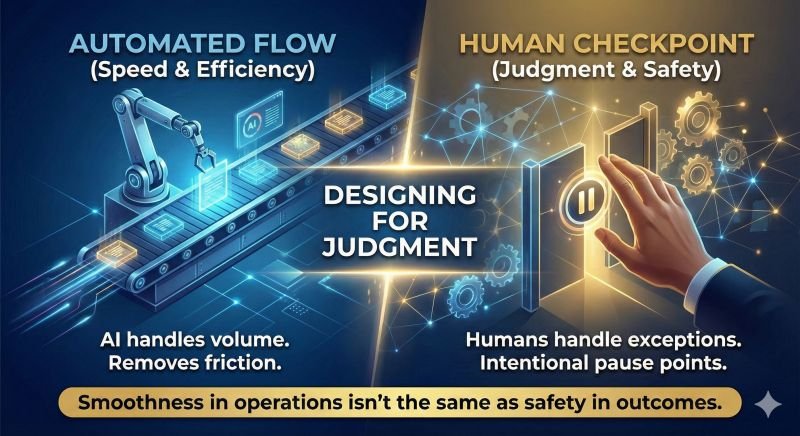
The most successful AI-enabled law firms tend to divide responsibilities clearly.
AI handles:
- Repetitive administrative work
- Document organization
- Initial drafting
- Information retrieval
- Workflow management
Humans remain responsible for:
- Ethical judgment
- Client relationships
- Risk assessment
- Strategic advice
- Exceptional cases
- Professional accountability
This partnership combines speed with wisdom.Neither replaces the other.
Before You Automate, Map Your Judgment Points
Every law firm should identify where valuable human judgment currently exists before introducing AI.
Questions worth asking include:
- Where are problems typically discovered?
- Which conversations reveal information clients did not initially provide?
- Which review steps prevent costly mistakes?
- Which decisions require professional discretion rather than procedural accuracy?
Only after understanding these judgment points should firms redesign workflows.Automation should enhance them—not eliminate them.
Conclusion
Efficiency is valuable.But speed alone does not create better legal outcomes.Artificial intelligence can remove unnecessary delays.It can also unintentionally remove the moments where experienced professionals notice what technology cannot.The future of legal practice is not about eliminating every form of friction.It is about preserving the friction that protects clients while removing the friction that wastes time.The best AI strategies do not ask how to remove humans from legal workflows.
They ask where human judgment matters most—and ensure it remains exactly where it belongs.
References
- Daniel Kahneman – Thinking, Fast and Slow (judgment and decision-making).
- Richard Susskind – Tomorrow’s Lawyers.
- Harvard Business Review – Human-AI collaboration and decision-making research.
- Stanford HAI – Research on human oversight in AI systems.
- NIST AI Risk Management Framework – Human governance and AI oversight.
- European Union AI Act – Human oversight requirements for high-risk AI systems.
- AI, Justice, and the Spirit of the Law: Why Human JudgmeAI, Justice, and the Spirit of the Law: Why Human Judgment Still Matters
- 2026: The Year Agentic AI Will Transform Legal Practice
- AI Governance Is Failing: Why Principles Alone Are No Longer Enough
- The 3.2-Hour Problem: How AI Is Transforming Contract Review Without Replacing Legal Judgment
- The Silent Revolution in Law Firms: Why AI Adoption Is Becoming a Competitive Advantage