The Startup Myth We Keep Believing
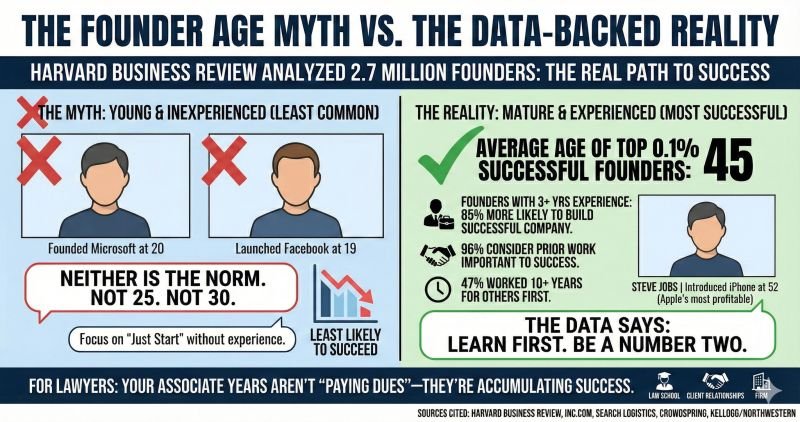
Stories about young entrepreneurs dominate business headlines.Bill Gates founded Microsoft at 20.Mark Zuckerberg launched Facebook at 19.
These extraordinary success stories have shaped a powerful narrative: the earlier you start, the greater your chances of success.
The data tells a different story.Large-scale research suggests that the most successful founders are rarely teenagers or recent graduates. Instead, they are professionals who have spent years building expertise before launching their own ventures.
For lawyers considering starting their own practice, this distinction matters.
What the Research Actually Shows
A landmark Harvard Business Review study analyzed more than 2.7 million startup founders.Its findings challenge one of entrepreneurship’s most common assumptions.Among the top-performing startups, the average founder was approximately 45 years old.
Additional research found that:
- Founders with at least three years of industry experience were significantly more likely to build successful companies.
- Nearly all successful entrepreneurs believe previous work experience contributed directly to their success.
- Almost half worked for another organization for at least ten years before launching their own business.
These findings suggest that experience is not a delay to entrepreneurship.It is often one of its strongest predictors.
Why Industry Experience Matters
Building a successful business requires far more than technical knowledge.Experience provides advantages that cannot easily be learned from books or courses.
Professionals develop:
- Industry expertise
- Professional networks
- Client relationships
- Commercial awareness
- Leadership skills
- Decision-making under pressure
These capabilities compound over time.By the time experienced professionals launch their own businesses, they are not starting from zero.They are building upon years of accumulated knowledge.
The Lesson for Lawyers
Many young lawyers dream of opening their own firm as quickly as possible.Ambition is valuable.But legal practice rewards experience.
Working under experienced partners teaches lessons rarely covered in law school, including:
- Building client trust
- Managing complex cases
- Developing referral networks
- Leading legal teams
- Pricing legal services
- Growing a sustainable practice
These experiences often become the foundation of future success.Years spent as an associate are not simply “paying dues.”They are investments in future leadership.
Learning Before Leading
The business world often celebrates founders.It pays less attention to the years that prepared them.Successful lawyers rarely become effective firm owners overnight.They first learn how successful firms operate.
They observe experienced leaders.They make mistakes while someone else carries the ultimate responsibility.This apprenticeship provides insights that become invaluable when running an independent practice.In many cases, becoming an exceptional number two is the fastest path toward becoming a successful number one.
Success Is a Long-Term Process
Even many famous entrepreneurs reached their greatest achievements later in life.Steve Jobs introduced the iPhone—arguably Apple’s most transformative product—when he was in his fifties.His success was built on decades of experience, setbacks, leadership, and learning.Professional growth is cumulative.
Knowledge compounds.Relationships compound.Judgment compounds.Entrepreneurship often does the same.
Building a Stronger Law Firm
Launching a law firm requires more than legal expertise.It demands business leadership.
Successful founders understand:
- Client acquisition
- Financial management
- Team leadership
- Marketing
- Operations
- Strategic decision-making
These capabilities are rarely mastered early in a legal career.They develop through practical experience over many years.
Conclusion
The entrepreneurial myth suggests that success belongs to those who start earliest.The evidence suggests something different.Experience matters.Industry knowledge matters.Professional relationships matter.For aspiring law firm founders, every year spent learning the profession is not time lost.It is preparation for building a stronger, more resilient, and ultimately more successful practice.The goal is not simply to start a law firm.It is to build one that lasts.
References
- Harvard Business Review – Research on 2.7 million startup founders.
- Kellogg School of Management (Northwestern University) – Studies on industry experience and entrepreneurial success.
- Inc.com – Research on founder career paths.
- Search Logistics – Analysis of entrepreneurial backgrounds.
- Crowdspring – Startup success and founder experience research.
- AI Adoption Starts with Trust, Not Technology
- Why AI Adoption Fails in Law Firms: The Middle Management Bottleneck
- The Leadership Gap: Why AI Resistance at the Top Puts Law Firms at Risk
- The AI Copyright Reckoning: Who Owns Creativity in the Age of Generative AI?
- AI Hallucinations Are No Longer a New Problem. They Are Becoming a Professional Responsibility Problem.