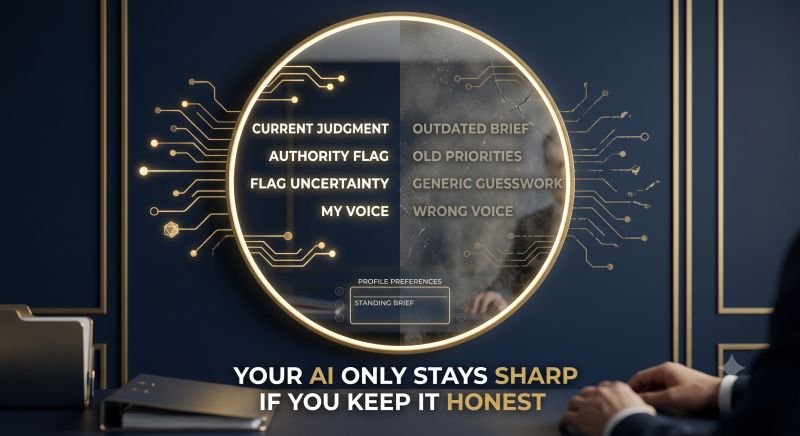
- Your AI Shouldn't Have to Meet You From Scratch Every Morning
- The Problem With Generic AI
- Treat Your Preferences as a Standing Brief
- The Four Questions That Matter
- The Interesting Part: Let AI Interview You
- But There Is a Governance Problem
- Your AI Brief Has a Shelf Life
- For Law Firms, This Becomes More Important
- The AI Operating System
- The Real Lesson
- Conclusion
- A Simple Starting Prompt
Your AI Shouldn’t Have to Meet You From Scratch Every Morning
A year ago, I filled in one text box in my AI settings.It looked insignificant.It wasn’t.In Claude, this feature is called Profile Preferences. I think of it as a standing brief—a set of instructions the model reads before I type a single word.Who I am.How I work.How I want to communicate.
What I consider good work.What I refuse to accept.The result was subtle but important.The AI stopped behaving like a general-purpose assistant and started responding within a framework that reflected how I actually think and work.For professionals, particularly lawyers, that distinction matters.
The Problem With Generic AI
A generic AI system does not know your professional standards.It doesn’t automatically know that you never want an authority invented.It doesn’t know that uncertainty should be explicitly flagged.It doesn’t know that client-facing communication should be clear, human, and free of unnecessary technical language.It doesn’t know which risks you consider unacceptable.So when you ask a generic AI for an answer, you’re not simply asking a capable system to do a task.
You’re asking a capable system to make assumptions about how the task should be done.In a regulated profession, those assumptions can become a problem.An inaccurate citation is not merely a bad answer.An unsupported legal conclusion can become a professional risk.A confident statement where uncertainty should have been disclosed can undermine client trust.The solution isn’t simply better prompting.It is better configuration.
Treat Your Preferences as a Standing Brief
A useful way to think about AI preferences is as a standing professional brief.
Instead of repeatedly explaining:“Don’t invent sources.””Tell me when you’re uncertain.””Use plain English for clients.””Challenge my assumptions.””Don’t make claims you cannot support.”
You define those principles once.Then they become part of the context in which the AI operates.The model still requires supervision.It can still make mistakes.
But the baseline changes.You are no longer starting every conversation from zero.
The Four Questions That Matter
When I built my own preferences, I didn’t simply write a list of instructions.I asked the AI to interview me first.One question at a time.
The purpose was to understand four things.
1. Who am I and what do I do?
The AI needs professional context.Your role.Your areas of expertise.The type of work you perform.The people you serve.The decisions you regularly make.Without this context, the model has to guess.
2. How should the AI communicate?
Should it be concise?Analytical?Formal?Direct?Should it challenge weak assumptions?Should it explain uncertainty?Should it use technical terminology or plain language?
Communication preferences are not cosmetic.They determine whether an AI output is actually usable.
3. What should it always do?
This is where professional standards become explicit.
For example:
- distinguish facts from assumptions;
- flag uncertainty;
- identify missing information;
- verify important authorities;
- explain reasoning where appropriate;
- preserve confidentiality;
- challenge unsupported conclusions.
These instructions create behavioural guardrails.
4. What should it never do?
This may be even more important.
For example:
- never fabricate a citation;
- never invent facts;
- never present speculation as certainty;
- never conceal uncertainty;
- never make a legal conclusion appear more authoritative than the evidence supports.
The strongest AI preferences are not simply descriptions of what you want.They define boundaries.
The Interesting Part: Let AI Interview You
The irony is that I didn’t write my preferences entirely by myself.I asked Claude to interview me.
The instruction was essentially:
“Before writing anything, interview me one question at a time about who I am, how I work, how I want you to communicate, what you should always do, and what you should never do. When you have enough information, draft my preferences as direct instructions.”
That changes the exercise.Instead of trying to guess what instructions an AI needs, you make the AI help you articulate your own professional operating system.The technology becomes a mirror.
But There Is a Governance Problem
There is one part of this process that is easy to overlook.Your preferences can become outdated.And outdated instructions do not necessarily disappear.They continue influencing the model.Your practice changes.Your priorities change.Your role changes.
Your communication style changes.You may become more comfortable with certain tools.You may develop stricter standards around others.But your old preferences can continue quietly steering the AI toward the person you used to be.That creates an unusual form of technological drift.
The system isn’t necessarily malfunctioning.Your instructions are simply no longer accurate.
Your AI Brief Has a Shelf Life
This is why I treat my preferences as something that needs periodic review.I would recommend revisiting them approximately every quarter.Not because it is another administrative task.Because the exercise is useful beyond AI.Read your preferences back to yourself.
Do they still describe how you work?Are the standards still relevant?Are there assumptions that no longer reflect your practice?Have your priorities changed?Have you learned something about AI that should change your guardrails?
Sometimes the most valuable discovery is not what needs to change in the AI.It is what has changed in you.
For Law Firms, This Becomes More Important
For an individual professional, AI preferences can improve consistency.For a law firm, the concept becomes significantly more consequential.
Imagine every lawyer using AI with completely different assumptions about:
- confidentiality;
- citation verification;
- legal research;
- client communication;
- human review;
- disclosure;
- risk tolerance.
The firm may technically have an AI policy.But if individual behaviour differs dramatically, the policy has limited practical value.This is where personal AI preferences can become part of a broader governance architecture.The firm establishes minimum standards.
Professionals can then build their own working preferences within those boundaries.
The AI Operating System
I increasingly think of this as an AI operating system for professional judgment.Not a replacement for expertise.Not a substitute for supervision.
A framework that tells the AI:This is who I am.This is how I work.This is what good looks like.These are my boundaries.These are the things you must never assume.
The more powerful AI becomes, the more important this layer becomes.Because capability without direction creates unpredictability.
The Real Lesson
The biggest mistake professionals make with AI is often not choosing the wrong model.It is failing to define what they expect from the model.We spend enormous amounts of time discussing which AI is smarter.Which model benchmarks better.Which tool is faster.Which platform has more features.
But a powerful system operating under poorly defined professional standards can still produce poor outcomes.
The question should not only be:“Which AI should I use?”
It should also be:“What should my AI understand about how I work before I ask it to do anything?”
Conclusion
Your AI should not have to rediscover your professional standards every morning.Give it a standing brief.Define who you are.Define how you work.Define what you value.Define what you will not tolerate.Then review that brief regularly.Because AI preferences are not permanent instructions.They are a reflection of your current professional judgment.And professional judgment evolves.The most sophisticated AI system in the world cannot compensate for instructions that describe a version of you that no longer exists.Your AI should evolve with your practice.
Not quietly keep you trapped in the one you left behind.
A Simple Starting Prompt
If you want to build your own preferences, start with this:
“I want to create my professional AI Profile Preferences. Before writing anything, interview me one question at a time. Ask about who I am and what I do, how I want you to communicate, what you should always do, what you should never do, and the professional standards you should follow. When you have enough information, draft a concise preferences block written as direct instructions to you that I can paste into my AI settings. Prioritise accuracy, transparency, uncertainty, professional judgment, and my specific working style.”
The important part isn’t the template.It’s the conversation that comes before it.Because the best AI configuration is not the one with the most instructions.It is the one that accurately captures how you expect intelligence to work on your behalf.
- AI Adoption Starts with Trust, Not Technology
- Why AI Adoption Fails in Law Firms: The Middle Management Bottleneck
- The Leadership Gap: Why AI Resistance at the Top Puts Law Firms at Risk
- The AI Copyright Reckoning: Who Owns Creativity in the Age of Generative AI?
- AI Hallucinations Are No Longer a New Problem. They Are Becoming a Professional Responsibility Problem.