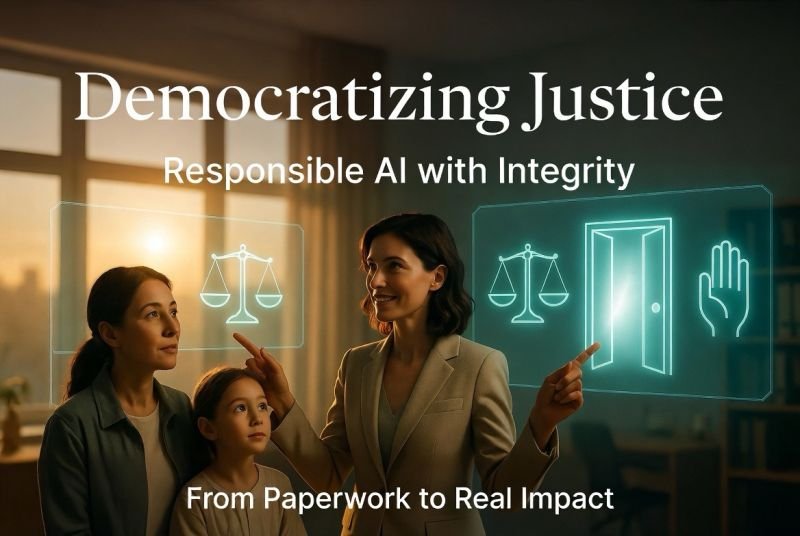
When Justice Arrives Too Late, It Stops Being Justice
Across Europe, legal aid organisations face an increasingly difficult challenge.
Demand for legal assistance continues to rise while funding, staffing, and volunteer capacity struggle to keep pace. Housing disputes, immigration matters, family protection cases, welfare appeals, and refugee support place enormous pressure on organisations whose mission is to ensure that justice is accessible to everyone—not only those who can afford legal representation.For many vulnerable individuals, delayed legal assistance is more than an inconvenience. It can mean eviction, deportation, financial hardship, or the loss of fundamental rights.
Artificial intelligence is often discussed as a tool for improving efficiency in commercial law firms. Yet one of its most profound applications may lie elsewhere: expanding access to justice.
A Case Study in Responsible AI Adoption
Consider the example of FairBridge Legal Aid, a nonprofit legal aid organisation serving low-income families, refugees, and vulnerable communities in Germany.By 2024, the organisation was struggling to meet demand.Growing numbers of clients seeking assistance with housing, immigration, benefits appeals, and domestic protection orders overwhelmed existing resources. Volunteers were exhausted, waiting lists lengthened, and many clients received assistance only after critical legal deadlines had already passed.
Recognising that technology alone could not solve these problems, Executive Director Maria Petrova chose a different path.Rather than deploying generic AI tools without oversight, FairBridge adopted a governance-first strategy focused on responsible, human-centred implementation.The objective was not to replace legal professionals.
It was to allow them to help more people.
Using AI to Support, Not Replace, Human Advocacy
The organisation introduced AI only in carefully selected areas where automation could improve efficiency without compromising professional judgment.
AI-assisted systems were used to:
- automate initial client intake
- summarise lengthy legal documents
- support preliminary legal research
- prioritise urgent matters through intelligent triage
- assist in preparing first drafts of appeals and legal submissions
- identify patterns that helped prioritise complex cases
Every AI-generated output remained subject to human review before being used in legal work.Technology accelerated preparation.Lawyers and advocates remained responsible for every legal decision.
Governance Before Automation
One of the most important aspects of FairBridge’s approach was that governance preceded deployment.
Each AI system was evaluated against key principles, including:
- compliance with the EU AI Act
- GDPR data protection requirements
- client confidentiality
- bias mitigation for culturally diverse client populations
- transparency of AI-assisted decision-making
- auditability and human oversight
Rather than asking, “Can AI perform this task?”, the organisation asked a more important question:
“Should AI perform this task, and under what safeguards?”That distinction transformed AI from a technological experiment into a trusted operational tool.
Expanding Access to Justice
The impact extended well beyond operational efficiency.By reducing administrative workload, FairBridge significantly increased its capacity to assist clients.The organisation was able to support substantially more individuals each year while improving preparation quality.Self-represented litigants received better-prepared documentation before appearing in court.
Volunteers spent less time on repetitive administrative work and more time advising clients, representing vulnerable individuals, and advocating for systemic reform.In effect, AI expanded the organisation’s ability to deliver justice without reducing the essential human relationship between lawyer and client.
Why Legal Aid May Benefit More Than Commercial Practice
Commercial law firms often evaluate AI primarily through the lens of profitability.Legal aid organisations face a different challenge.Their most limited resource is not revenue.It is capacity.Every administrative hour saved through responsible automation creates additional time for legal professionals to serve people who might otherwise receive no assistance at all.
In this context, AI becomes more than an efficiency tool.It becomes a mechanism for improving access to justice.
Responsible AI Is Essential in Public Interest Law
Legal aid work frequently involves highly sensitive personal information, vulnerable individuals, and significant power imbalances.
Poorly governed AI systems can introduce risks including:
- algorithmic bias
- inaccurate legal information
- privacy breaches
- reduced transparency
- diminished accountability
For this reason, governance cannot be treated as an afterthought.Human oversight, explainability, and rigorous compliance remain essential components of responsible AI adoption.The objective is not simply faster legal services.It is fairer and more trustworthy legal services.
The Future of Access to Justice
As legal demand continues to outpace available resources across many jurisdictions, responsible AI offers an opportunity to rethink how legal aid is delivered.Technology cannot replace empathy.It cannot replace advocacy.It cannot replace professional legal judgment.But it can remove administrative barriers that prevent lawyers and volunteers from focusing on the work that matters most.
When implemented responsibly, AI does not diminish justice.It helps extend it.For legal aid organisations, that may be one of the most meaningful applications of artificial intelligence yet.
Conclusion
The future of legal aid will not be determined by technology alone.It will be shaped by how thoughtfully that technology is governed.Organisations that combine responsible AI with strong human oversight can expand their reach, reduce staff burnout, improve case preparation, and make legal support accessible to far more people without compromising ethics or professional responsibility.The greatest promise of AI in law may not be helping the largest firms become more profitable.
It may be helping society ensure that justice becomes accessible to everyone who needs it.
References
- European Union. Regulation (EU) 2024/1689 – Artificial Intelligence Act (EU AI Act).
- European Commission. Artificial Intelligence Act Implementation Resources.
- European Union Agency for Fundamental Rights (FRA). Access to Justice in Europe.
- Council of Europe. Ethical Charter on the Use of Artificial Intelligence in Judicial Systems.
- OECD. OECD AI Principles.
- UNESCO. Recommendation on the Ethics of Artificial Intelligence (2021).
- AI Adoption Starts with Trust, Not Technology
- Why AI Adoption Fails in Law Firms: The Middle Management Bottleneck
- The Leadership Gap: Why AI Resistance at the Top Puts Law Firms at Risk
- The AI Copyright Reckoning: Who Owns Creativity in the Age of Generative AI?
- AI Hallucinations Are No Longer a New Problem. They Are Becoming a Professional Responsibility Problem.