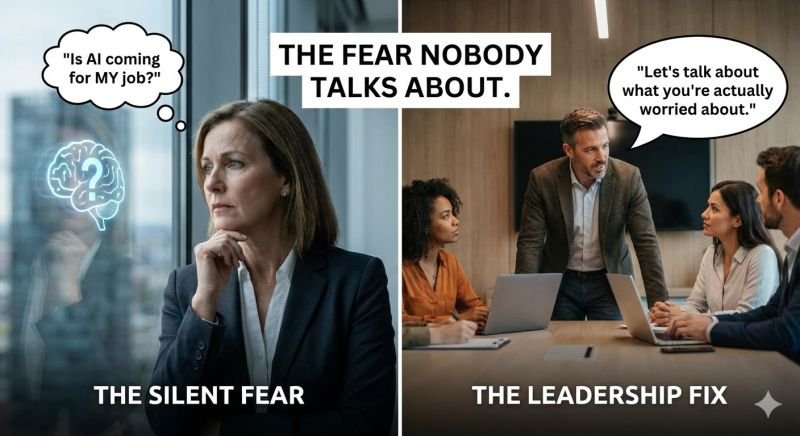
The Fear Nobody Talks About
Many leaders believe AI adoption is a technology problem.It often isn’t.It is a trust problem.Across law firms and professional services, employees are not simply evaluating new software. They are asking a much more personal question:
“What happens to me?”
Until that question is answered honestly, adoption will remain slow—regardless of how powerful the technology becomes.
Resistance Is Often Fear in Disguise
When leaders see low AI adoption, they often assume people are resistant to change.Sometimes that is true.More often, employees are responding to uncertainty.
For years, headlines have warned that AI will replace lawyers, accountants, marketers, developers, and knowledge workers.
After hearing those messages repeatedly, many professionals naturally associate AI with redundancy rather than opportunity.
The result is predictable.People hesitate.Not because they dislike innovation.Because they fear becoming unnecessary.
The Anxiety Reaches Every Level
This concern is not limited to junior employees.Senior managers, department heads, and partners can experience the same uncertainty.AI changes workflows.Workflows influence organizational structures.Organizational structures affect careers.
When leaders overlook these concerns, they misunderstand what is actually slowing transformation.The barrier is rarely capability.It is confidence.
Silence Creates Its Own Story
One of the biggest mistakes organizations make is failing to explain how AI will affect individual roles.In the absence of clear communication, employees create their own narratives.Those narratives are often far more alarming than reality.
Questions begin to circulate:
- Will my role disappear?
- Will AI replace my expertise?
- Will performance expectations change?
- Will fewer people be needed?
Without transparent leadership, uncertainty quickly becomes resistance.
Start with Conversation, Not Efficiency
Many AI initiatives begin with presentations about productivity, automation, and cost savings.Those benefits matter.But they rarely address the emotional reality employees are experiencing.A better starting point is a simple question:
“What concerns you most about AI?”
Listening before persuading changes the conversation.People who feel heard are far more willing to learn.Trust creates openness.Openness creates adoption.
AI Should Remove Tasks, Not Purpose
Successful organizations frame AI differently.Rather than focusing exclusively on efficiency, they explain how AI can remove repetitive work while allowing professionals to concentrate on higher-value activities.
For lawyers, that may mean spending less time formatting documents and more time advising clients.For managers, it may mean reducing administrative work while increasing strategic leadership.The goal is not to replace human contribution.It is to elevate it.
Leadership Builds Psychological Safety
Employees watch leaders closely during periods of change.When leaders acknowledge uncertainty honestly instead of dismissing it, they create psychological safety.That does not require having every answer.It requires openness.
Organizations that encourage questions, experimentation, and continuous learning tend to adopt AI more successfully than those relying solely on mandates.People rarely embrace change because they are instructed to.They embrace it because they trust the people leading it.
Conclusion
Technology alone does not transform organizations.People do.The most successful AI initiatives recognize that adoption is as much about psychology as it is about software.Fear ignored becomes resistance.Fear acknowledged becomes conversation.Conversation builds trust.
And trust is often the foundation upon which lasting AI transformation is built.
References
- Research on organizational change management and employee engagement.
- Studies on AI adoption in professional services.
- Literature on workplace psychology during digital transformation.
- Research on psychological safety and leadership.
- Studies on AI implementation in knowledge-based organizations.
- AI Adoption Starts with Trust, Not Technology
- Why AI Adoption Fails in Law Firms: The Middle Management Bottleneck
- The Leadership Gap: Why AI Resistance at the Top Puts Law Firms at Risk
- The AI Copyright Reckoning: Who Owns Creativity in the Age of Generative AI?
- AI Hallucinations Are No Longer a New Problem. They Are Becoming a Professional Responsibility Problem.