Artificial Intelligence Doesn’t Automatically Make Justice Fairer
Artificial intelligence is often described as objective.Unlike humans, algorithms are said to have no emotions, no prejudice, and no personal interests.They simply analyse data and produce results.It is an attractive narrative.Unfortunately, it is also incomplete.AI does not eliminate bias from legal systems.In many cases, it preserves it.Sometimes, it amplifies it.The reason is simple.
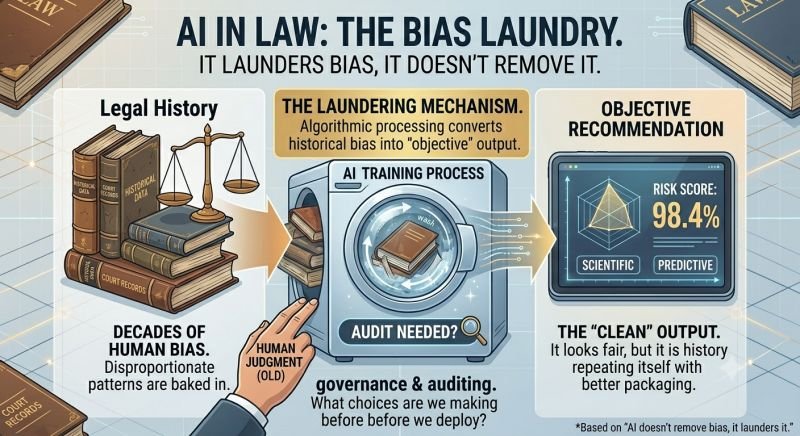
Artificial intelligence learns from history.If history is biased, the model learns bias.
Data Is Never Neutral
Every AI system depends on data.Legal AI models are trained on judicial decisions, sentencing records, case outcomes, contracts, regulatory materials, and decades of legal practice.These datasets appear objective because they consist of real cases decided by real courts.Yet they also reflect the social and institutional realities in which those decisions were made.Historical legal systems have not always treated every individual equally.
Disparities based on race, gender, socioeconomic background, disability, or geography have been documented across numerous jurisdictions.
When AI learns from these historical patterns, it cannot distinguish between what happened and what should have happened.
It learns both.
Bias Hidden Behind Mathematics
One of AI’s greatest strengths is consistency.It applies the same logic repeatedly across thousands of cases.But consistency is valuable only if the underlying logic is fair.
If historical sentencing data consistently imposed harsher penalties on certain communities, an AI trained on that data may identify those outcomes as statistically normal.
The result appears objective.It arrives as a probability score.A risk assessment.A confidence percentage.A recommendation generated through sophisticated statistical analysis.Yet beneath the mathematical precision lies something much older.Historical human judgment.The algorithm has not removed bias.
It has translated it into numbers.
The Illusion of Objectivity
Numbers carry authority.People naturally trust quantitative outputs more than subjective opinions.This creates a dangerous illusion.An AI recommendation often appears more reliable simply because it is expressed mathematically.A risk score of 87%.A predicted success rate of 72%.A sentencing recommendation based on thousands of previous cases.These figures create the appearance of scientific certainty.
But algorithms do not discover justice.They identify patterns.Whether those patterns deserve to be repeated is an ethical question—not a statistical one.
Prediction Is Not Fairness
Artificial intelligence is exceptionally good at predicting outcomes.It is far less capable of evaluating whether those outcomes are just.This distinction is critical.A predictive model may accurately forecast that certain defendants historically received longer sentences.That prediction may be statistically correct.It does not follow that those sentencing patterns should continue.
Law has never been solely about predicting what courts will do.It is also about questioning whether existing practices reflect the principles of justice society wishes to uphold.
Responsible AI Requires Governance
The existence of bias is not an argument against artificial intelligence.It is an argument for responsible governance.
Before deploying AI in legal practice, organisations should ask difficult but necessary questions:
- What data was used to train the model?
- Does the dataset reflect historical discrimination?
- Has the system been independently audited for bias?
- Can recommendations be explained and challenged?
- Who remains accountable when AI recommendations are followed?
These questions matter far more than claims about accuracy alone.Accuracy without fairness can simply automate injustice.
Human Oversight Remains Essential
No AI system should become the final decision-maker in matters affecting legal rights.The role of AI should be to support legal professionals—not replace them.Lawyers and judges possess something algorithms do not.The ability to recognise when historical patterns themselves deserve scrutiny.Professional judgment allows legal practitioners to ask:
Is this recommendation legally correct?
Is it ethically acceptable?
Does it produce a just outcome?
Those questions require human reasoning.
Not machine optimisation.
From AI Ethics to AI Governance
As AI becomes increasingly embedded in courts, law firms, government agencies, and regulatory bodies, discussions about fairness must move beyond technicalperformance.Governance is not simply about ensuring systems function properly.It is about ensuring they operate consistently with the values of the legal system itself.
Transparency.Accountability.Human oversight.Explainability.Bias monitoring.These are not optional safeguards.They are the foundations of trustworthy legal AI.
Conclusion
Artificial intelligence has enormous potential to improve legal services.It can accelerate research, identify relevant precedents, reduce administrative burden, and support better-informed legal decision-making.But fairness does not emerge automatically from technology.Algorithms inherit the assumptions embedded within the data they learn from.Without careful governance, AI risks giving historical bias the appearance of scientific objectivity.The question is therefore not whether AI should be used in law.It is whether we are willing to govern it responsibly before we trust it with decisions that shape people’s lives.Because justice is not created by algorithms.
Justice is created by the principles that guide the people who design, deploy, and oversee them.
References
- European Union. Regulation (EU) 2024/1689 – Artificial Intelligence Act.
- National Institute of Standards and Technology (NIST). AI Risk Management Framework.
- UNESCO. Recommendation on the Ethics of Artificial Intelligence (2021).
- OECD. OECD AI Principles.
- Cathy O’Neil. Weapons of Math Destruction.
- Virginia Eubanks. Automating Inequality.
- Goudarzi, S. The Quantum Guardian.
- Goudarzi, S. AI for Legal Professionals.
- AI Adoption Starts with Trust, Not Technology
- Why AI Adoption Fails in Law Firms: The Middle Management Bottleneck
- The Leadership Gap: Why AI Resistance at the Top Puts Law Firms at Risk
- The AI Copyright Reckoning: Who Owns Creativity in the Age of Generative AI?
- AI Hallucinations Are No Longer a New Problem. They Are Becoming a Professional Responsibility Problem.