- The Law Is Facing a Question It Was Never Designed to Answer
- Argentina's Proposal Reignited an Old Debate
- A Third Category
- Personhood Should Never Mean Ownerless Autonomy
- Why Existing Legal Categories Are Becoming Insufficient
- The Difference Between the Virtual Person and the "Non-Human Corporation"
- Governance Before Crisis
- The Future of AI Governance
- Conclusion
- References
The Law Is Facing a Question It Was Never Designed to Answer
For centuries, legal systems have recognised only two types of legal actors.The first is the natural person—a human being who possesses rights and responsibilities by virtue of birth.The second is the legal person—an organisation such as a corporation, foundation, or government entity that exists because the law grants it legal personality.These two categories have served commerce, government, and society remarkably well.But artificial intelligence is beginning to expose a gap between them.
Today, autonomous AI agents can negotiate contracts, manage investment portfolios, purchase goods, draft legal documents, coordinate supply chains, and make operational decisions without continuous human supervision.They are no longer merely executing instructions.
Increasingly, they are making choices that carry legal consequences.The question is no longer whether AI can act.The question is how the law should understand those actions.
Argentina’s Proposal Reignited an Old Debate
Recently, Argentine President Javier Milei proposed creating a new legal category—a “non-human corporation.”The proposal envisions AI-driven organisations capable of operating with limited liability while requiring little or no direct human management.
The reaction was immediate.Some commentators warned that the proposal could become a form of regulatory arbitrage, allowing organisations to distance themselves from responsibility.
Others argued that AI should never possess any form of legal recognition beyond that of ordinary software.The debate quickly became polarised.Should AI receive legal personhood?Or should it remain nothing more than property?
In reality, this may be the wrong question.
A Third Category
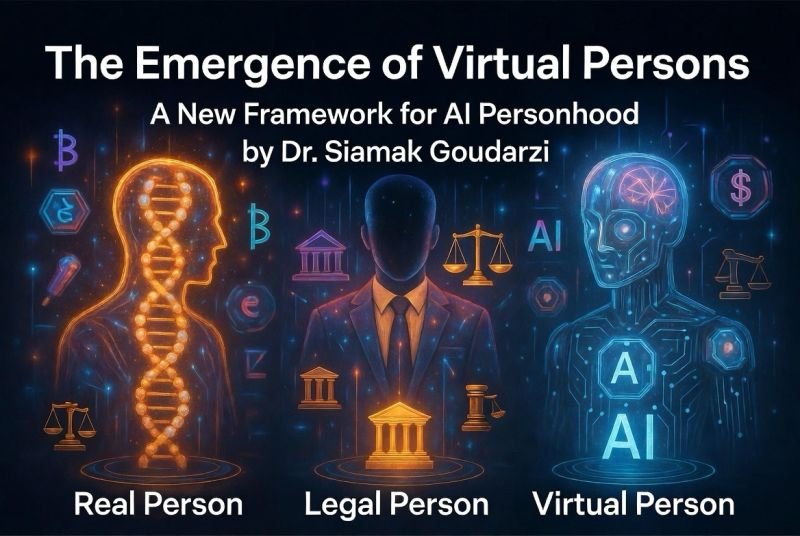
In 2024, in The Emergence of Virtual Persons, I proposed a different framework.Rather than forcing AI into one of the two existing legal categories, I argued for recognising a third category: the Virtual Person.A Virtual Person is not a human being.
Nor is it simply another corporation.It is an autonomous AI system capable of making decisions, interacting with people, and producing legal consequences within clearly defined limits.Most importantly, however, Virtual Personhood is not designed to grant independence from responsibility.
It is designed to strengthen accountability.
Personhood Should Never Mean Ownerless Autonomy
Much of the public debate assumes that recognising AI in law necessarily means giving machines independent rights.That is not the purpose of the Virtual Person model.Every Virtual Person remains attached to a legally responsible guardian.
That guardian may be:
- an individual;
- a corporation;
- or another recognised legal institution.
The AI gains operational recognition.The guardian retains ultimate legal responsibility.This distinction matters enormously.Corporate personhood did not eliminate accountability.It organised accountability.Virtual Personhood should perform exactly the same function.Recognition should never become a mechanism for escaping liability.
It should become a mechanism for locating it more clearly.
Why Existing Legal Categories Are Becoming Insufficient
Current law generally treats AI as property.Property does not negotiate.Property does not independently allocate resources.Property does not continuously interact with thousands of people while adapting its behaviour over time.Autonomous AI increasingly performs all of these functions.Yet treating AI as a natural person would be equally inappropriate.AI possesses neither consciousness nor moral agency in the human sense.The challenge is therefore not choosing between existing categories.
It is recognising that neither category fully reflects technological reality.Law has evolved before.When corporations transformed commerce, legal systems created corporate personhood because existing categories no longer worked.
Artificial intelligence may require a similar evolution.
The Difference Between the Virtual Person and the “Non-Human Corporation”
Although both concepts attempt to address increasingly autonomous AI systems, they rest upon fundamentally different principles.The proposed non-human corporation seeks to minimise direct human involvement.The Virtual Person seeks to preserve human accountability.One removes humans from the centre of legal responsibility.The other deliberately keeps them there.This difference is more than technical.It reflects two competing philosophies of governance.
One prioritises operational autonomy.The other prioritises responsibility.
As AI systems become more capable, that distinction will become increasingly important.
Governance Before Crisis
History shows that law rarely develops before technology.Instead, new technologies emerge first.Disputes follow.Courts respond.Legislatures eventually intervene.Artificial intelligence is following the same pattern.The challenge for lawyers is not simply interpreting today’s law.It is anticipating tomorrow’s legal questions before they become tomorrow’s litigation.Creating new legal concepts before they become urgently necessary is not speculative.It is one of the oldest functions of legal scholarship.
The legal vocabulary we build today determines the quality of the legal solutions available tomorrow.
The Future of AI Governance
Artificial intelligence will continue becoming more autonomous.More organisations will rely on AI agents to negotiate, purchase, advise, manage, and coordinate increasingly complex activities.
Eventually, legal systems will need clearer answers to questions such as:
- Who bears responsibility when autonomous AI causes harm?
- Can AI enter legally binding agreements?
- Should counterparties know they are negotiating with an AI?
- How should liability be allocated between developers, operators, owners, and autonomous systems?
- What legal status best protects society without discouraging innovation?
These questions cannot be answered through engineering alone.
They require legal imagination.
Conclusion
The debate over AI personhood is often framed as a choice between recognising machines as legal actors or denying them any legal status whatsoever.That binary choice may itself be outdated.Artificial intelligence increasingly occupies territory between traditional legal categories.
The concept of the Virtual Person attempts to recognise that reality while preserving the principle that has always underpinned the rule of law:
Every exercise of power must remain connected to human responsibility.
Technology will continue evolving.The law will eventually follow.The question is whether we will design the legal categories before the first major governance crisis—or after it.
References
- Goudarzi, S. The Emergence of Virtual Persons (2024).
- Goudarzi, S. AI for Legal Professionals.
- European Parliament. Civil Law Rules on Robotics (2017/2103(INL)).
- European Union. Regulation (EU) 2024/1689 – Artificial Intelligence Act.
- OECD. OECD AI Principles.
- UNESCO. Recommendation on the Ethics of Artificial Intelligence (2021).
- Harvard Law School Center on the Legal Profession – Research on AI and Legal Innovation.
- Recent public statements and reporting regarding Argentina’s proposed “non-human corporation” framework and the international debate on AI legal personhood.
- AI Adoption Starts with Trust, Not Technology
- Why AI Adoption Fails in Law Firms: The Middle Management Bottleneck
- The Leadership Gap: Why AI Resistance at the Top Puts Law Firms at Risk
- The AI Copyright Reckoning: Who Owns Creativity in the Age of Generative AI?
- AI Hallucinations Are No Longer a New Problem. They Are Becoming a Professional Responsibility Problem.