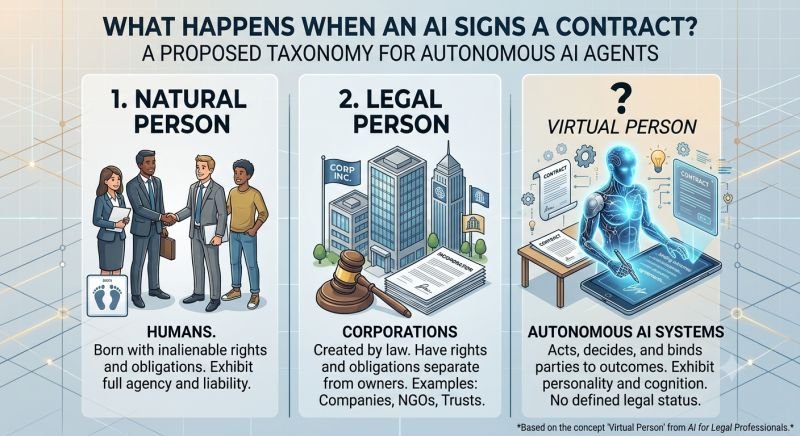
- The Law Recognises Two Kinds of Persons. AI Fits Neither.
- The Idea of the Virtual Person
- Legal Personality Has Always Evolved
- AI Is Already Producing Legal Consequences
- The Liability Problem
- Ownership and Intellectual Property
- Transparency in AI Negotiation
- The Debate Is Not New
- Why Taxonomy Matters
- The Virtual Person as a Governance Framework
- Conclusion
- References
The Law Recognises Two Kinds of Persons. AI Fits Neither.
For centuries, legal systems have operated with a simple but remarkably effective distinction.There are natural persons—human beings who possess legal rights and obligations by virtue of birth.There are legal persons—corporations, charities, governments, and other entities that exist because the law grants them legal personality. Although they are not human, they can own property, enter contracts, sue and be sued, and bear legal responsibilities.
These two categories have provided the foundation of modern private and commercial law.Artificial intelligence is beginning to challenge that foundation.Increasingly autonomous AI systems are no longer merely assisting humans. They are negotiating commercial terms, managing financial portfolios, executing transactions, drafting agreements, and making decisions that produce real legal consequences.
The question is no longer whether AI can participate in legal activity.The question is whether our existing legal categories remain sufficient.
The Idea of the Virtual Person
In my books, AI for Legal Professionals and The Emergence of Virtual Persons, I introduce the concept of the Virtual Person.A Virtual Person is not a human being.Nor is it simply another piece of software.
It is an AI-driven entity that demonstrates a combination of autonomy, intelligence, persistence, and the ability to interact with humans in ways that resemble intentional decision-making.
Unlike traditional software, which performs predefined instructions, increasingly autonomous AI agents can plan, negotiate, adapt, and execute complex tasks with limited human intervention.
Their actions increasingly create legal consequences.That distinction matters.
Because law has always adapted when new actors emerged in society.
Legal Personality Has Always Evolved
Legal personhood did not begin with corporations.It developed gradually because economic and social reality demanded it.Businesses needed to own property independently of their shareholders.They needed to enter contracts.They needed continuity beyond the lives of their founders.The law responded by creating the legal fiction of corporate personality.
No one argues that a corporation is biologically human.Yet the law recognises it as a legal actor because doing so creates certainty, accountability, and commercial stability.Artificial intelligence may eventually present a similar challenge.
Not because AI is human.But because increasingly autonomous systems are performing functions previously carried out only by recognised legal actors.
AI Is Already Producing Legal Consequences
This is no longer a hypothetical discussion.
Modern AI agents can:
- negotiate commercial terms;
- draft contracts;
- monitor regulatory compliance;
- manage investment portfolios;
- coordinate procurement processes;
- execute predefined transactions across multiple systems;
- make operational decisions that affect businesses and individuals.
Humans remain legally responsible for these activities today.But practical reality is changing.As AI becomes more autonomous, identifying the true decision-maker becomes increasingly difficult.
The law traditionally assumes that responsibility follows human intention.What happens when intention is distributed across developers, operators, organisations, and autonomous systems?
The Liability Problem
Every legal system requires someone to bear responsibility when harm occurs.Suppose an autonomous AI agent negotiates a contract that causes significant financial loss.Who should be liable?
Possible candidates include:
- the software developer;
- the organisation deploying the system;
- the individual supervising the AI;
- the client who authorised the task;
- or some combination of them.
Existing legal frameworks generally reject the idea that AI itself can bear legal liability.Yet the greater the autonomy granted to AI systems, the more difficult existing doctrines become to apply consistently.This is not merely a technological question.It is a jurisprudential one.
Ownership and Intellectual Property
The same uncertainty appears in intellectual property law.If an autonomous AI system designs a commercially valuable invention, drafts a patent specification, writes software, or creates artistic works, who owns the resulting intellectual property?The programmer?The user?The organisation operating the system?Current legal systems provide different answers depending on jurisdiction and the type of intellectual property involved.
As AI-generated content becomes increasingly sophisticated, these questions will only become more significant.
Transparency in AI Negotiation
Imagine negotiating a complex commercial agreement.The other party appears responsive, analytical, and commercially sophisticated.Only after signing the contract do you discover that you were negotiating entirely with an autonomous AI agent.Should disclosure have been mandatory?
Many legal systems already recognise duties of transparency in areas involving consumer protection, financial services, and automated decision-making.
As AI increasingly participates in negotiations, informed consent may require parties to know whether they are interacting with a human representative or an autonomous system.Transparency is not merely an ethical preference.It may become a legal necessity.
The Debate Is Not New
The possibility of granting autonomous AI a distinct legal status has already been considered.In 2017, the European Parliament explored the controversial concept of electronic personhood within discussions on civil law rules for robotics.The proposal generated significant criticism and was ultimately not adopted.yMany argued that existing legal frameworks were sufficient.
Others warned that recognising electronic personhood could undermine human accountability.The proposal disappeared.The problem did not.
Since then, generative AI, large language models, and autonomous AI agents have advanced at extraordinary speed, making the underlying legal questions more pressing than ever.
Why Taxonomy Matters
Lawyers spend their careers drawing distinctions.Employee or contractor.Public or private.Civil or criminal.Natural person or legal person.Every legal consequence depends upon classification.Artificial intelligence increasingly occupies territory between existing legal categories.Treating autonomous AI simply as property ignores its growing operational independence.Treating it as a human would be equally inappropriate.
The challenge is not choosing between the existing categories.It is determining whether a new category is required.
The Virtual Person as a Governance Framework
The concept of the Virtual Person should not be understood as an attempt to grant human rights to machines.Nor is it an effort to free developers or organisations from responsibility.Its purpose is far more practical.The Virtual Person provides a governance framework for analysing autonomy, accountability, transparency, and legal responsibility where increasingly intelligent systems operate with delegated authority.
It offers a conceptual bridge between traditional legal doctrine and emerging technological reality.Rather than asking whether AI deserves legal personality, we should first ask whether our current legal categories remain capable of governing increasingly autonomous systems effectively.
If they are not, legal evolution becomes inevitable.
Conclusion
Throughout history, law has evolved whenever society created new forms of organisation capable of producing legal consequences.Corporations transformed commercial law.Digital commerce transformed contract law.Artificial intelligence may now require another evolution.Whether future legal systems ultimately recognise some form of Virtual Personhood remains uncertain.What seems increasingly difficult to deny is that autonomous AI challenges assumptions on which existing legal personality has long depended.The question is no longer whether AI will participate in legally significant decisions.It already does.The question is whether our legal system will continue treating increasingly autonomous decision-makers as ordinary software—or whether a new legal category will eventually emerge.
The answer may define the next generation of jurisprudence.
References
- European Parliament. Civil Law Rules on Robotics (2017/2103(INL)).
- European Union. Regulation (EU) 2024/1689 – Artificial Intelligence Act.
- OECD. OECD AI Principles.
- Goudarzi, S. The Emergence of Virtual Persons.
- Goudarzi, S. AI for Legal Professionals.
- AI Adoption Starts with Trust, Not Technology
- Why AI Adoption Fails in Law Firms: The Middle Management Bottleneck
- The Leadership Gap: Why AI Resistance at the Top Puts Law Firms at Risk
- The AI Copyright Reckoning: Who Owns Creativity in the Age of Generative AI?
- AI Hallucinations Are No Longer a New Problem. They Are Becoming a Professional Responsibility Problem.