- The Productivity Secret Most Lawyers Ignore
- Burnout Has Become a Business Risk
- Why Successful Leaders Prioritize Physical Health
- Better Lawyers Need More Than More Hours
- Health Is a Competitive Advantage
- AI Can Improve Efficiency—But It Cannot Replace Human Energy
- Building a Healthier Law Firm Culture
- Conclusion
- References
The Productivity Secret Most Lawyers Ignore
Law firms invest heavily in technology.
They purchase new software, improve workflows, automate repetitive tasks, and increasingly adopt artificial intelligence.
Yet many overlook one of the simplest drivers of long-term performance.
Health.
When billionaire entrepreneur Richard Branson was asked by Tim Ferriss how to become more productive, his answer was surprisingly simple:
“Work out.”
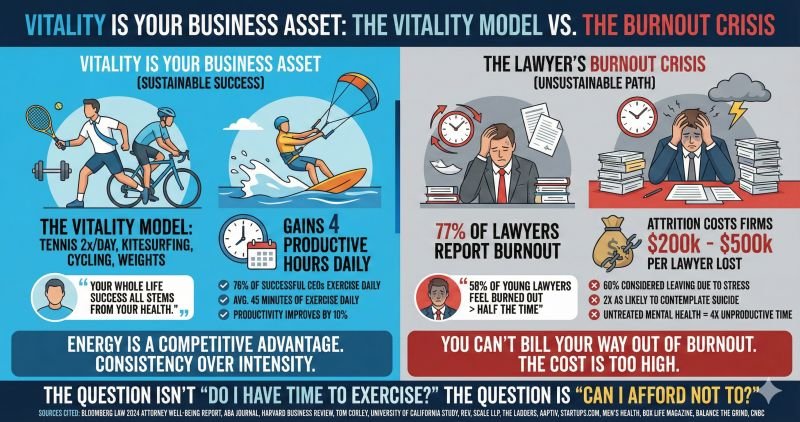
Rather than recommending another productivity framework or management technique, Branson argued that regular exercise gives him approximately four additional productive hours every day.
For legal professionals facing growing workloads and rising stress, that lesson may be more relevant than ever.
Burnout Has Become a Business Risk
The legal profession has long been associated with long hours, high pressure, and demanding clients.Today, those pressures are reaching unprecedented levels.
Recent research highlights the scale of the problem:
- Approximately 77% of lawyers report experiencing burnout.
- More than half of younger lawyers experience burnout frequently.
- Many attorneys have considered leaving the profession because of chronic stress.
Burnout affects far more than personal wellbeing.
It reduces:
- Decision quality
- Client service
- Creativity
- Leadership effectiveness
- Business development
- Employee retention
For law firms, burnout is no longer simply an HR issue.It is a strategic business challenge.
Why Successful Leaders Prioritize Physical Health
Research consistently shows that many successful CEOs maintain regular exercise routines.
Studies indicate that:
- Around 76% of successful CEOs exercise daily.
- Executives average roughly 45 minutes of physical activity each day.
- Employees who exercise regularly often report higher productivity and improved focus.
This pattern is unlikely to be accidental.
Exercise improves:
- Energy levels
- Cognitive performance
- Emotional regulation
- Stress resilience
- Sleep quality
- Long-term health
These benefits directly influence leadership performance and professional judgment.
Better Lawyers Need More Than More Hours
Many legal professionals respond to increasing demands by simply working longer.Unfortunately, longer hours rarely produce better judgment.
Legal practice depends heavily on:
- Critical thinking
- Strategic analysis
- Negotiation
- Communication
- Sound judgment
These abilities decline when physical and mental wellbeing deteriorate.A lawyer operating under constant exhaustion is more likely to overlook details, communicate poorly, and make costly mistakes.Sustainable performance requires sustainable energy.
Health Is a Competitive Advantage
Richard Branson has often argued that success begins with health.His reasoning is straightforward.When people care for their physical wellbeing, they strengthen their mental performance.Greater mental clarity allows better decisions, stronger leadership, and higher-quality work.The same principle applies inside law firms.Health is not separate from professional performance.It supports it.
Lawyers who maintain physical wellbeing are often better equipped to:
- Build stronger client relationships
- Handle complex legal problems
- Lead teams effectively
- Adapt to technological change
- Maintain consistent performance over long careers
AI Can Improve Efficiency—But It Cannot Replace Human Energy
Artificial intelligence is transforming legal practice.It can automate document review, accelerate legal research, and reduce administrative work.However, AI cannot replace the qualities clients value most.
Clients still rely on lawyers for:
- Judgment
- Trust
- Empathy
- Strategic advice
- Professional responsibility
Those qualities depend on healthy, engaged professionals.Technology can improve efficiency.Only people can provide wisdom.
Building a Healthier Law Firm Culture
Forward-thinking firms increasingly recognize that wellbeing is not a luxury.It is part of sustainable business strategy.
Practical initiatives may include:
- Encouraging regular physical activity
- Supporting flexible working arrangements
- Reducing unnecessary administrative burdens
- Promoting mental health resources
- Measuring long-term wellbeing alongside financial performance
Healthy lawyers create healthier firms.Healthy firms create better client outcomes.
Conclusion
The legal industry often searches for competitive advantage through technology, automation, and efficiency.Those investments matter.But one of the highest-return investments may be far simpler.Health.Exercise improves energy.Energy improves judgment.Judgment strengthens client relationships.And better lawyers build stronger law firms.In an era where AI increasingly performs routine legal work, human performance becomes even more valuable.The future of legal practice will not belong only to the firms with the most advanced technology.
It will belong to the firms whose people are healthy enough to use that technology wisely.
References
- Bloomberg Law – Attorney Well-Being Report (2024)
- ABA Journal – Research on lawyer burnout and wellbeing.
- Harvard Business Review – CEO time management and executive productivity.
- Tom Corley – Change Your Habits, Change Your Life.
- University of California – Research on exercise and workplace productivity.
- Richard Branson interviews discussing productivity and exercise.
- Tim Ferriss – Interviews with Richard Branson on productivity habits.
- AI, Justice, and the Spirit of the Law: Why Human JudgmeAI, Justice, and the Spirit of the Law: Why Human Judgment Still Matters
- 2026: The Year Agentic AI Will Transform Legal Practice
- AI Governance Is Failing: Why Principles Alone Are No Longer Enough
- The 3.2-Hour Problem: How AI Is Transforming Contract Review Without Replacing Legal Judgment
- The Silent Revolution in Law Firms: Why AI Adoption Is Becoming a Competitive Advantage