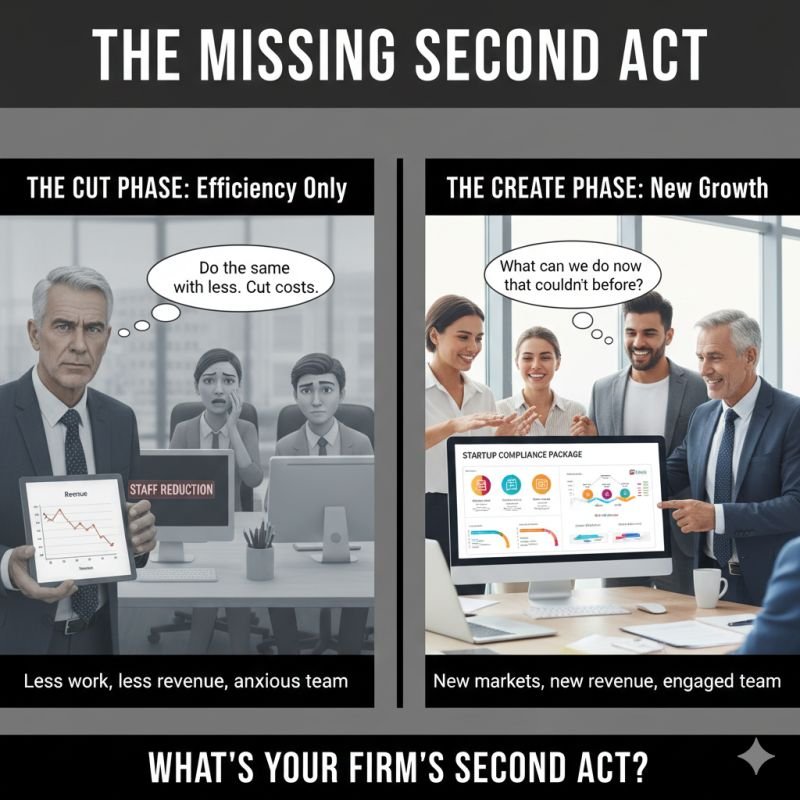
Efficiency Is Only the First Chapter
Ask most managing partners why they are investing in artificial intelligence, and the answer is usually the same.Efficiency.Reduce administrative work.Draft documents faster.Review contracts more quickly.Lower operating costs.These are sensible goals.
But they are also incomplete.The firms that stop at efficiency risk making themselves leaner without becoming stronger.The real opportunity begins after the time savings appear.
The Problem with the “Cut” Mindset
Every technological revolution follows a familiar pattern.The first instinct is to automate.To eliminate repetitive work.To reduce costs.To improve productivity.That phase is necessary.
But it is also where most of the anxiety lives.Lawyers worry about billable hours.Associates worry about their future.Partners worry about profitability.If the only story leadership tells is one of reduction, AI quickly becomes associated with loss.Less work.Fewer hours.Fewer people.That is not an inspiring vision of the future.
The Missing Second Act
Imagine two firms implementing the same AI tools.The first uses AI to review contracts in half the time.Clients are billed fewer hours.Revenue declines.The work becomes more efficient, but the business becomes smaller.The second firm reaches the same efficiency gains.Instead of stopping there, it asks a different question.
“What can we build with the time we’ve just created?”
The partners launch a fixed-fee compliance service for early-stage companies.A market they previously lacked the capacity to serve.New clients arrive.New revenue streams emerge.Junior lawyers work on innovative matters instead of repetitive drafting.The technology is identical.The strategy is not.
AI Should Create Capacity, Not Just Savings
Efficiency creates something far more valuable than reduced costs.It creates capacity.Capacity to serve new clients.Capacity to develop new products.Capacity to strengthen relationships.Capacity to invest in innovation.Firms that view AI only as a cost-saving tool overlook its greatest contribution.It expands what the organisation is capable of becoming.
Ask a Better Question
Many firms ask:
“How can AI help us do the same work faster?”
A more valuable question is:
“What work becomes possible because AI now handles everything else?”
That shift changes the entire conversation.
Instead of replacing work, AI becomes a platform for creating entirely new services, new business models, and new client experiences.Innovation begins where efficiency ends.
Growth Is More Powerful Than Reduction
People rarely become excited about cost-cutting.They become excited about building something new.The firms that successfully adopt AI give their lawyers a future they want to participate in.They connect efficiency to opportunity.They replace fear with ambition.Technology alone cannot inspire people.Purpose can.
The Future Belongs to Builders
Artificial intelligence will undoubtedly make legal work more efficient.That is no longer the interesting question.The firms that lead the next decade will not simply be the fastest.They will be the most imaginative.They will use AI to create services that did not previously exist.Reach clients they could never previously serve.Solve problems that were once economically impossible to address.Efficiency is the beginning.
Creation is the destination.
Conclusion
Artificial intelligence should never be the end of a firm’s strategy.It should be the beginning of a new one.The first act is optimisation.The second act is innovation.Law firms that remain focused solely on cutting costs may become more efficient, but they risk shrinking their ambitions at the same time.The firms that ask what AI makes newly possible will discover opportunities their competitors never see.The most important question is not how AI helps you do yesterday’s work faster.It is what tomorrow’s practice looks like because AI changed what is possible.
References
- Research on AI adoption and business transformation.
- Literature on innovation strategy and digital transformation.
- Studies on legal technology and law firm management.
- Research on organisational innovation and AI implementation.
- Publications on AI-enabled business model innovation.
- AI, Justice, and the Spirit of the Law: Why Human JudgmeAI, Justice, and the Spirit of the Law: Why Human Judgment Still Matters
- 2026: The Year Agentic AI Will Transform Legal Practice
- AI Governance Is Failing: Why Principles Alone Are No Longer Enough
- The 3.2-Hour Problem: How AI Is Transforming Contract Review Without Replacing Legal Judgment
- The Silent Revolution in Law Firms: Why AI Adoption Is Becoming a Competitive Advantage