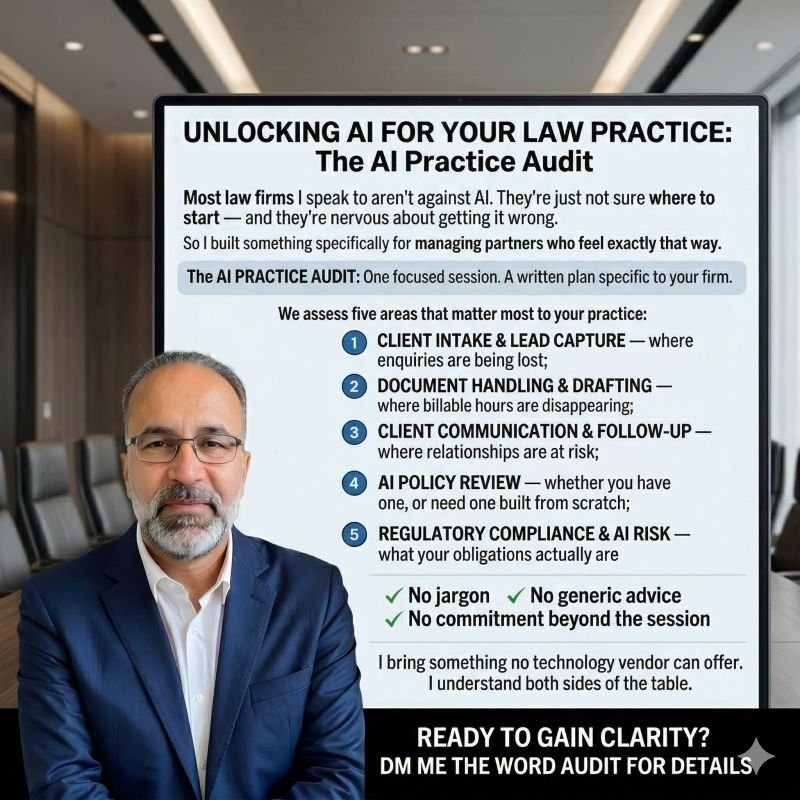
- The Biggest Barrier Isn't Technology
- AI Is Not a Product. It Is a Strategy.
- What Is an AI Practice Audit?An AI Practice Audit is a structured assessment of how artificial intelligence could support a law firm's existing operations.
- Five Areas Every Law Firm Should Review
- AI Should Reduce Decisions, Not Replace Judgment
- Every Law Firm Is Different
- Conclusion
- References
The Biggest Barrier Isn’t Technology
Most law firms are not resisting artificial intelligence.They’re hesitating.Not because they doubt its potential.Because they are unsure where to begin—and they understand that implementing AI incorrectly could create legal, ethical, and professional risks.That hesitation is reasonable.
The legal profession has always demanded precision, accountability, and trust. AI should strengthen those principles, not compromise them.The question is no longer whether AI belongs in legal practice.The question is how to introduce it responsibly.
AI Is Not a Product. It Is a Strategy.
Many firms begin by purchasing AI tools.That is often the wrong starting point.Technology should solve clearly identified business problems—not create new ones.
Before selecting software, firms should understand:
- Where time is being lost
- Which administrative processes create bottlenecks
- Which tasks consume billable hours unnecessarily
- Where client experience can be improved
- Which regulatory obligations apply to AI use
Only after those questions are answered does technology become valuable.
What Is an AI Practice Audit?An AI Practice Audit is a structured assessment of how artificial intelligence could support a law firm’s existing operations.
Rather than recommending generic software, the audit evaluates the firm’s current workflows and identifies practical opportunities for improvement.The goal is not automation for its own sake.The goal is better legal practice.
Five Areas Every Law Firm Should Review
A comprehensive AI assessment typically focuses on five operational areas.
1. Client Intake and Lead Management
Potential clients are often lost before the first consultation.
AI can assist with:
- Initial enquiries
- Appointment scheduling
- Lead qualification
- Client follow-up
- Response time improvement
Improving intake often produces one of the highest returns on investment.
2. Document Drafting and Knowledge Management
Lawyers spend significant time producing documents that follow familiar structures.
AI can support:
- Draft preparation
- Contract templates
- Legal research assistance
- Document summarisation
- Knowledge retrieval
Human review remains essential, but repetitive drafting can become substantially more efficient.
3. Client Communication
Many firms lose opportunities through inconsistent communication rather than poor legal work.
AI can assist by:
- Tracking unanswered emails
- Preparing follow-up messages
- Monitoring client communication
- Generating meeting summaries
- Creating task reminders
Better communication strengthens client relationships without replacing personal interaction.
4. AI Governance and Internal Policy
Introducing AI without clear policies creates unnecessary risk.
Every firm should establish guidance covering:
- Confidential information
- Approved AI tools
- Human review requirements
- Staff responsibilities
- Data protection obligations
- Ethical use of generative AI
Governance should develop alongside adoption—not afterwards.
5. Regulatory Compliance and Risk Management
As AI regulation continues to evolve, firms must understand their professional responsibilities.
An assessment should consider:
- Privacy obligations
- Data security
- Client confidentiality
- Record keeping
- Professional liability
- Emerging AI regulations
Compliance is no longer simply an IT issue.
It is becoming a core legal governance responsibility.
AI Should Reduce Decisions, Not Replace Judgment
The greatest value of AI is not replacing lawyers.It is reducing unnecessary cognitive load.Administrative work, repetitive drafting, scheduling, document organisation, and information retrieval can increasingly be supported by intelligent systems.What remains uniquely human is judgment.
Legal advice depends on context, ethics, interpretation, negotiation, and responsibility.Those functions cannot simply be automated.
Every Law Firm Is Different
No two firms lose time in exactly the same way.A litigation practice faces different challenges from a commercial firm.
A boutique practice has different priorities from a multinational partnership.For that reason, AI implementation should never begin with software.
It should begin with understanding how the firm actually operates.Technology should adapt to practice—not the other way around.
Conclusion
Artificial intelligence is becoming part of modern legal practice.The firms that benefit most are unlikely to be those that adopt the largest number of AI tools.They will be the firms that understand where AI genuinely creates value, where human judgment remains essential, and how to integrate both responsibly.An AI Practice Audit provides that starting point.Not by recommending technology first.But by identifying where technology can support better legal work.
References
- Research on AI adoption in legal services.
- Literature on legal operations and workflow optimisation.
- AI governance and responsible AI implementation frameworks.
- Emerging AI regulation and professional compliance guidance.
- Research on legal technology and law firm innovation.
- AI, Justice, and the Spirit of the Law: Why Human JudgmeAI, Justice, and the Spirit of the Law: Why Human Judgment Still Matters
- 2026: The Year Agentic AI Will Transform Legal Practice
- AI Governance Is Failing: Why Principles Alone Are No Longer Enough
- The 3.2-Hour Problem: How AI Is Transforming Contract Review Without Replacing Legal Judgment
- The Silent Revolution in Law Firms: Why AI Adoption Is Becoming a Competitive Advantage