Every Contract Carries an Invisible Cost
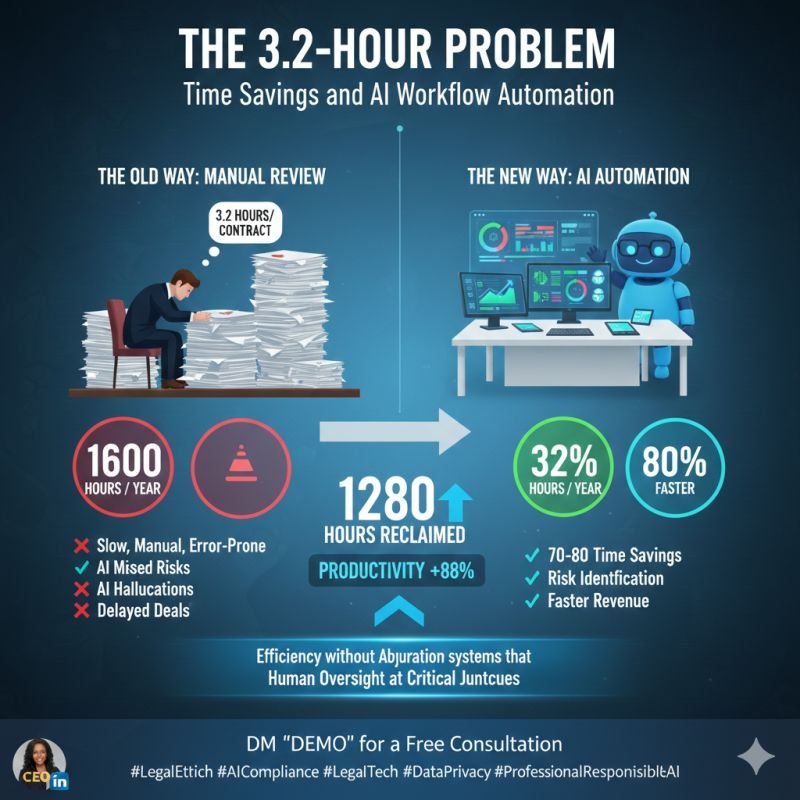
Contract review is one of the most essential responsibilities in legal practice.It protects organisations from financial exposure, regulatory breaches, and commercial disputes. Yet it is also one of the most time-intensive tasks lawyers perform.According to recent legal industry research, legal teams spend an average of 3.2 hours reviewing a single contract.
For a law firm or in-house legal department processing 500 contracts each year, that amounts to:
- 1,600 hours of legal review
- Nearly 200 working days
- Thousands of billable hours devoted primarily to identifying repetitive clauses, inconsistencies, and compliance issues
This isn’t simply a workload challenge.It is a capacity challenge.As contract volumes continue to increase, firms must decide whether to hire more lawyers—or redesign how legal work is performed.
AI Is Changing the Economics of Contract Review
Generative AI and modern Legal AI platforms have fundamentally changed what is possibleRather than replacing lawyers, these systems automate the repetitive aspects of contract analysis, allowing legal professionals to focus on interpretation, negotiation, and strategic advice.
Industry studies report that AI-assisted contract review can deliver:
- 70–80% reduction in review time
- Up to 85% faster document processing
- Productivity improvements reported by 88% of legal teams
Returning to our exampleA firm spending 1,600 hours annually reviewing contracts could reduce that workload to approximately 320 hoursThat represents 1,280 hours reclaimed every year.
Those hours can be redirected toward:
- Client advisory work
- Complex negotiations
- Business development
- Litigation strategy
- Regulatory compliance
- Relationship building
The value extends far beyond simple efficiency.
Speed Is Only Part of the Story
Many discussions about AI focus exclusively on time savings.That is understandable but incomplete.Modern AI contract review systems also improve consistency.Unlike humans, AI does not become fatigued after reviewing dozens of nearly identical agreements.It applies the same review logic repeatedly across thousands of documents.
AI can rapidly identify:
- Missing clauses
- Non-standard language
- Inconsistent obligations
- Expired provisions
- Compliance risks
- Deviations from approved templates
For organisations managing high contract volumes, this consistency can significantly reduce operational risk.
Why Human Judgment Still Matters
Despite impressive advances, AI should never become the final decision-maker in legal work.Contract interpretation is rarely binary.Commercial context matters.Negotiation strategy matters.Client objectives matter.Professional judgment matters.An AI system may correctly identify an unusual indemnity clause.
It cannot fully understand whether accepting that clause aligns with the client’s broader commercial strategy.Similarly, AI may classify a provision as high risk when an experienced lawyer recognises that it reflects standard practice within a specific industry.This distinction is critical.AI identifies patterns.Lawyers interpret meaning.
Governance Is the Real Competitive Advantage
As AI becomes embedded in legal workflows, governance becomes increasingly important.
Successful firms are not asking:“How quickly can we automate?”
They are asking:“Where should automation stop and human judgment begin?”
Every AI implementation should address key governance questions:
- Who remains responsible for final legal advice?
- How are AI-generated recommendations reviewed?
- How are errors identified and corrected?
- How is confidential client data protected?
- How are audit trails maintained?
- How do firms comply with professional and regulatory obligations?
These questions are not technical.They are governance questions.
Human-in-the-Loop Is Becoming Best Practice
The strongest legal AI implementations share one common principle:Human-in-the-loop review.Rather than replacing legal professionals, AI performs the first layer of analysis.
Lawyers then:
- Verify findings
- Assess commercial implications
- Exercise legal judgment
- Make final recommendations
This model combines the strengths of both.AI contributes speed, consistency, and scalability.Lawyers contribute experience, ethics, negotiation, and accountability.The result is not automated law.It is augmented legal practice.
Beyond Efficiency: Creating Capacity
Perhaps the greatest value of AI is not that lawyers work faster.It is that lawyers regain time for work that clients genuinely value.
Instead of spending hours searching for repetitive clauses, lawyers can focus on:
- Solving complex legal problems
- Advising business leaders
- Negotiating stronger agreements
- Developing client relationships
- Building new legal services
Technology becomes an enabler—not a replacement.
Final Thoughts
The future of contract review is unlikely to be fully manual.Nor will it be fully autonomous.The firms that achieve the greatest competitive advantage will be those that combine AI efficiency with rigorous human oversight.AI can analyse contracts at extraordinary speed.
Lawyers provide context, judgment, ethics, and accountability.That combination is where the real value lies.The question is no longer whether AI belongs in contract review.The question is whether your firm is designing workflows that allow technology and professional judgment to work together.
References
- World Commerce & Contracting (WorldCC). The State of AI in Contracting 2025.
- Thomson Reuters. Future of Professionals Report 2025.
- LexisNexis. Legal Technology Survey 2025.
- Deloitte. Generative AI in Legal Services Report 2025.
- McKinsey & Company. The Economic Potential of Generative AI.
- Gartner. AI Trends in Enterprise Legal Operations 2025.
- American Bar Association. Formal Opinion 512: Generative Artificial Intelligence Tools (2024).
- International Association for Contract & Commercial Management (WorldCC). Contract Lifecycle Management Research.